
If you teach upper-elementary reading, you’ve probably seen this happen: we ask for the main idea, and a student gives us either the topic (“It’s about sharks”) or a play-by-play summary of every paragraph. That’s not because they aren’t thinking. It’s usually because teaching main idea is harder than it looks. Students have to hold details in mind, sort which ones matter, and then say what those details add up to. That is a big lift, especially in nonfiction.
The good news is that when we unpack the standard in plain language and teach a clear process, students start to get traction. In this post, we’ll look at RI.4.2, clear up the difference between topic, main idea, and summary, and walk through a practical scaffold that moves students from key details to a solid main idea statement. I’ll also share question stems you can use right away in small group, whole group, or conferences.
What RI.4.2 is really asking students to do
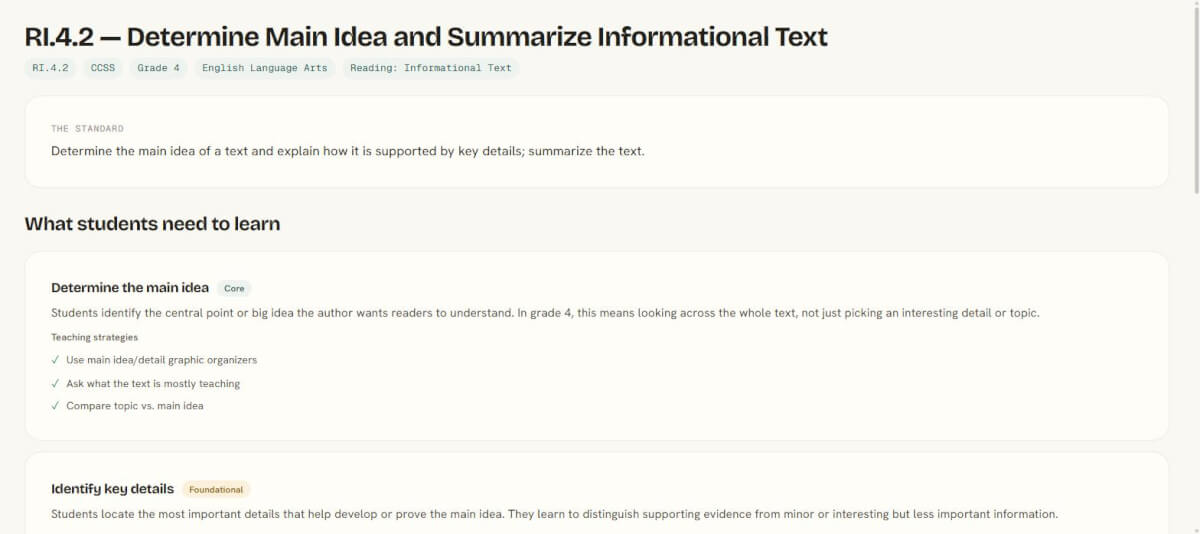
Fourth-grade RI.4.2 asks students to determine the main idea of a text and explain how it is supported by key details, then summarize the text. In other words, students are doing three related but different jobs:
- Figure out the main idea
- Connect key details to that main idea
- Summarize the text
That sequence matters. Summary is not the same thing as main idea. If students jump straight to retelling, they often miss the thinking the standard is actually asking for.
If you want a teacher-friendly way to break standards into teachable parts, take a look at PlanSpark's Standards Unpacker. If you want a free option you can browse without signing up, use PlanSpark's free Standards Unpacker. And for the specific standard, here is the RI.4.2 breakdown: RI.4.2.
RI.4.2 in plain teacher language
When I explain this standard to teachers, I usually say it like this: students need to read an informational text, notice the most important details, figure out what those details are mostly teaching, and then give a brief summary without retelling everything.
That plain-language version helps us plan instruction. If students are struggling, we can ask: Is the problem that they can’t find key details? Can’t tell which details matter most? Can’t combine details into a main idea? Or can they identify a main idea but still write a summary that is too long?
Teaching main idea starts with clearing up three easy-to-confuse terms
Before students can succeed, we need to be very explicit about vocabulary. In upper elementary, many of our readers use these terms interchangeably unless we slow down and separate them.
1. Topic: what the text is about
The topic is usually short—often just a word or phrase.
- Sharks
- The water cycle
- How animals survive winter
A topic is not enough for RI.4.2. It tells us the subject, but not what the author wants us to understand about that subject.
2. Main idea: what the author is saying about the topic
The main idea is the message or big point the details support.
- Sharks have physical traits and behaviors that help them survive in the ocean.
- The water cycle moves water through a repeating process on Earth.
- Animals survive winter in different ways, such as migrating, hibernating, or adapting their behavior.
Main idea answers: What do these important details add up to?
3. Summary: the main idea plus the most important supporting details
A summary is a brief retelling of the text’s key points. It includes the main idea and major details, but leaves out extra examples, interesting side facts, and minor information.
Here’s the simple distinction I use with students:
- Topic = one or two words
- Main idea = one sentence about the topic
- Summary = a few sentences that include the main idea and key details
When we make those differences visible on anchor charts and model them again and again, students begin to hear the difference in their own responses.
Why students summarize instead of synthesize
This is one of the biggest hurdles in teaching main idea. Many students think, “If I tell everything I read, I’m proving I understood it.” And honestly, that makes sense from their point of view. Retelling feels safer than combining ideas.
Here are the common reasons students summarize instead of synthesize:
- They are collecting details but not sorting them. Everything feels equally important.
- They haven’t been taught a process for combining details. We sometimes ask for a main idea before students know how to build one.
- They confuse “tell what it was about” with “tell the author’s point.”
- They rely on sentence-level recall. They remember a fact from paragraph 2 and another from paragraph 4, but not the relationship between them.
- They think longer answers sound smarter. So they produce a summary when we needed one precise sentence.
That’s why a details-first scaffold works so well. It slows the thinking down and makes synthesis visible.
A details-first scaffold for teaching main idea
When students struggle with main idea, I don’t start by asking, “What’s the main idea?” I start with details. Specifically: gather key details, sort them, then name what they add up to.
This routine works in whole group, guided reading, intervention, and even science or social studies literacy blocks.
Step 1: Gather key details
First, students identify important details from the text. Not every fact belongs on the list. We want the details that seem central to what the author is teaching.
You might have students jot details in boxes, highlight with a purpose, or use sticky notes—whatever fits your classroom. The key is that students must be able to explain why a detail matters.
Question stems for Step 1:
- Which details seem most important?
- What does the author repeat or emphasize?
- Which facts teach us something important about the topic?
- If you could keep only three details, which would you choose?
- Which details help you understand the text best?
Teacher tip: If students over-highlight, give a limit. “Choose no more than three or four details from this section.” Limits force prioritizing.
Step 2: Sort the details
Next, have students look across their details and ask what goes together. This is the synthesis step students often skip.
They might sort details by subtopic, repeated idea, cause/effect relationship, or common pattern. In nonfiction, details often cluster naturally. Once students see the cluster, the main idea becomes much easier to state.
Question stems for Step 2:
- Which details seem connected?
- Do any of these details go together for the same reason?
- What pattern do you notice across these details?
- What are these details mostly showing or teaching?
- If you made a label for this group of details, what would it be?
Teacher tip: A quick move here is to ask students to complete the sentence, “These details all show that…” without worrying yet about perfect wording.
Step 3: Name what the details add up to
Only after gathering and sorting do we ask for the main idea. Now students are not guessing. They are building the statement from evidence.
Question stems for Step 3:
- What do these details add up to?
- What is the author teaching us about this topic?
- How would you say the big idea in one sentence?
- What is true across all of these details?
- If the author had to say the most important point in one line, what would it be?
Teacher tip: If students write a topic instead of a main idea, prompt with: “That tells me what the text is about. Now tell me what the author says about it.”
Step 4: Turn the main idea into a short summary
Once the main idea is clear, summary comes next. Students can use the main idea sentence and add two or three supporting details.
Question stems for Step 4:
- Which details best support this main idea?
- What should be included in a short summary?
- Which details are important enough to keep, and which can be left out?
- Can you say the main idea and key details in two or three sentences?
If you want ready-made questions that keep students grounded in the text, PlanSpark's Text-Dependent Questions Generator can help you build prompts aligned to the passage and skill.
A worked nonfiction example
Let’s use a simple informational passage topic: sea turtles. Imagine students read a short article explaining how sea turtles survive in the ocean.
What students might notice first
- Sea turtles have flippers that help them swim long distances.
- Some sea turtles migrate thousands of miles.
- Their shells help protect them from predators.
- Sea turtles can hold their breath underwater for long periods.
- Hatchlings face danger, but adult turtles have traits that help them survive.
Step 1: Gather key details
We might guide students to choose these as key details because they are not random facts. They all connect to survival.
Step 2: Sort the details
Now we ask: what do these details have in common?
Students may say:
- These details are all about how sea turtles live in the ocean.
- These details all show what helps sea turtles stay safe or survive.
That’s the bridge to main idea.
Step 3: Name what they add up to
A strong main idea might be:
Sea turtles have body features and behaviors that help them survive in the ocean.
Notice how that is different from the topic sea turtles and different from a summary. It is a single sentence that unites the details.
Step 4: Build a summary
A short summary could sound like this:
Sea turtles have body features and behaviors that help them survive in the ocean. Their flippers help them swim long distances, their shells protect them from predators, and they can hold their breath underwater for long periods.
That summary includes the main idea plus supporting details, without listing every fact from the article.
Practical classroom moves that help main idea stick
Use short nonfiction passages first
When students are learning the process, shorter texts are best. A dense article with multiple sections can overwhelm the skill we’re trying to teach.
Model wrong answers on purpose
Show students a topic, a summary, and a main idea, then ask them to identify which is which. For example:
- “Sea turtles”
- “Sea turtles have body features and behaviors that help them survive in the ocean.”
- “Sea turtles swim long distances, have shells, and can hold their breath…”
This comparison helps students hear the differences more clearly.
Teach students to use the phrase “add up to”
That language is concrete and memorable. Instead of asking only, “What’s the main idea?” ask, “What do these details add up to?” It nudges students toward synthesis.
Keep anchor charts simple
For upper elementary, clarity beats decoration. Try a three-column chart:
- Topic
- Key details
- Main idea
Or a four-column version that adds summary at the end.
Practice across content areas
Science and social studies are excellent places for teaching main idea. Informational text in those blocks gives students more opportunities to apply the same thinking with authentic content.
What to listen for when conferring
In conferences or small groups, listen closely to student language. Their wording tells us where the breakdown is.
- If a student names only the subject, they need support moving from topic to main idea.
- If a student lists many facts, they need support sorting details and synthesizing.
- If a student gives a broad statement with no evidence, they need support connecting the main idea to key details.
One of the most useful prompts I know is: “Which details made you think that?” That one question reveals a lot.
Final thoughts on teaching main idea in upper elementary
Teaching main idea gets easier when we stop treating it like a guessing game. Our students do better when we show them a repeatable process: gather key details, sort them, and then name what they add up to. That process honors the thinking RI.4.2 really requires.
If your students keep slipping into summary, that’s not failure—it’s information. It tells us they may need more support with synthesis, not more reminders to “read carefully.” With a details-first scaffold, clear question stems, and lots of nonfiction practice, we can help students move from listing information to understanding what it means.
If you’d like an easier way to plan around standards and text-based comprehension skills, explore PlanSpark's free Standards Unpacker or try PlanSpark's Standards Unpacker inside the app. Then bring the process into tomorrow’s reading block and see what your students’ details add up to.