
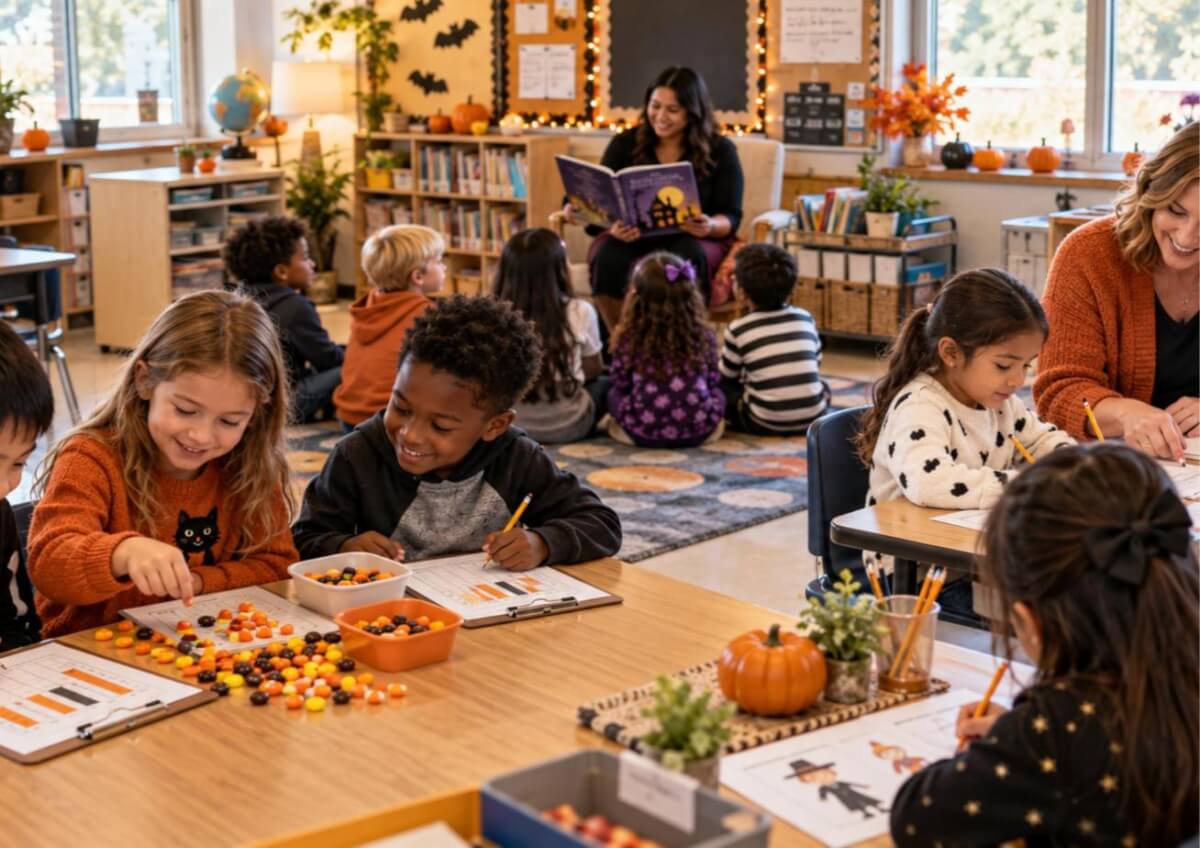
If you've ever looked up on the Friday before Halloween and thought, Well, this group is not settling into a quiet worksheet today, you're in good company. Our students are buzzing, the schedules are off, and even our steadiest routines can feel a little wobbly. That is exactly why halloween classroom activities that still teach matter so much. Instead of fighting the energy, we can channel it into lessons that feel festive and still protect the learning goal.
The good news? We do not need a lost day to give kids something seasonal. We just need a few smart swaps. Below are five low-prep ideas for K-5 teachers that keep engagement high and instruction intact, plus a simple last-hour routine for those extra-excited afternoons.
Why Halloween Week Calls for a Different Kind of Planning
By late October, many of our students are carrying a lot of excitement into the room. Some are thinking about costumes. Some are counting down to candy. Some are simply thrown off by assemblies, hallway decorations, and a short week. On days like that, a teacher's job is not to pretend the energy is not there. It is to use it wisely.
That means choosing activities with three features:
- Low prep for us, because October is already full.
- Clear academic purpose, so we are not just filling time.
- Built-in movement, novelty, or choice, so students can actually stay with us.
When we plan this way, halloween classroom activities that still teach become some of the most memorable lessons of the week.
5 Halloween Classroom Activities That Still Teach
1. Costume Character Description Writing
This one works beautifully in grades K-5 because it can stretch or simplify depending on what your writers need.
The idea: Students describe a costume, real or imagined, as if they are introducing a character in a story.
What it teaches:
- Descriptive writing
- Adjectives and precise word choice
- Sentence expansion
- Character traits
- Main idea and supporting details
How to run it:
- Show a few costume images, or let students think of a costume they know.
- Model a simple description: “The astronaut wore silver boots, a shiny helmet, and walked with slow, careful steps.”
- Ask students to include appearance, actions, and one likely personality trait.
- For older students, add a twist: write from the point of view of the character or include a short opening paragraph to a narrative.
Grade-level ideas:
- K-1: Draw the costume and complete sentence frames such as “My character is ___.” “They wear ___.”
- 2-3: Write a descriptive paragraph with at least three details.
- 4-5: Write a character sketch with dialogue or internal thinking.
Teacher tip: If you want a quick themed practice page without making it from scratch, create one through PlanSpark's Worksheet Generator and keep the same writing standard while giving it a seasonal feel.
2. Candy Graphing and Data Talks
If candy is already on students' minds, we can turn that interest into math. This is one of those activities that looks festive but stays tightly aligned to your objective.
The idea: Use real or picture-based candy categories for graphing, tallying, comparing, and interpreting data.
What it teaches:
- Counting and categorizing
- Bar graphs and picture graphs
- Comparing quantities
- Addition and subtraction with data
- Mean, median, or fractions for upper elementary
How to run it:
- Give students a small set of candy images, mini erasers, colored counters, or a sample class data set.
- Have them sort by type, color, or chocolate vs. non-chocolate.
- Create a graph individually or as a class.
- Ask follow-up questions: “Which category has the most?” “How many more students chose chocolate than gummies?”
Grade-level ideas:
- K-1: Sort and count, then make a picture graph.
- 2-3: Build a bar graph and answer comparison questions.
- 4-5: Analyze class survey data and write conclusions using evidence from the graph.
Teacher tip: No actual candy required. In fact, picture cards often keep the lesson cleaner, fairer, and easier to manage before dismissal.
3. Mystery Reader Read-Aloud with Text Evidence Questions
This is a favorite because it gives students the fun of a surprise while preserving strong literacy instruction.
The idea: Invite a mystery reader, perhaps a staff member, librarian, principal, or family volunteer, to read a seasonal picture book. Then follow with text-dependent questions.
What it teaches:
- Listening comprehension
- Story elements
- Inferencing
- Text evidence
- Speaking and listening skills
How to run it:
- Choose a mentor text with just enough suspense, humor, or Halloween flavor without making it too scary for your age group.
- Keep the mystery reader hidden until the reveal, if possible.
- After the read-aloud, ask students to answer questions that require them to point to words, pictures, or events from the text.
- Have partners discuss before sharing out.
Sample questions:
- What clue tells us the character is nervous?
- Which illustration helps you understand the setting?
- What happened first, next, and last?
- What evidence shows the problem was solved?
Teacher tip: Keep the structure exactly like your usual comprehension lesson. The novelty is the guest and the theme, not the standard.
4. Spooky Science or STEM in 20 Minutes
You do not need a full-blown craft day to bring in science. A short investigation can absorb that extra energy and still build academic habits.
The idea: Try a quick pumpkin, shadow, or “mystery substance” investigation with a recording sheet.
What it teaches:
- Observation
- Prediction
- Measurement
- Cause and effect
- Scientific explanation
Simple options:
- Sink or float: Predict whether small seasonal objects will sink or float.
- Pumpkin measurement: Estimate and measure height, circumference, or weight.
- Shadow study: Trace shadows at different times and discuss how they change.
Grade-level ideas:
- K-2: Focus on predicting, observing, and drawing results.
- 3-5: Add written explanations using because, therefore, and evidence from observations.
Teacher tip: Keep materials in bins and directions to three steps or fewer. On a high-energy day, simple beats fancy every time.
5. Vocabulary Hunt or Seasonal Reading Response Stations
When students need movement, stations can save the day. The key is to keep each station short, familiar, and directly tied to your current unit.
The idea: Use Halloween-themed words, short passages, or task cards in stations that practice the same literacy skills you already teach.
What it teaches:
- Vocabulary development
- Context clues
- Main idea
- Sequencing
- Written response
Possible stations:
- Match vocabulary words to pictures or definitions
- Read a short passage and find the main idea
- Sequence events from a seasonal story
- Write one text-based response on a sticky note
Teacher tip: This is another easy place to use PlanSpark's Worksheet Generator for themed pages that still match your standards and skill focus.
How to Keep the Learning Goal Intact
Here is the honest truth: the theme is not the lesson. The objective is the lesson. That small mindset shift helps us avoid activities that are cute but disconnected.
Before we use any seasonal task, it helps to ask:
- What exact skill am I teaching?
- How will students show me they practiced it?
- Could I explain this lesson to an administrator in one sentence?
For example:
- Not just “We are doing a Halloween writing activity.”
- But “Students are using descriptive details and character traits to write a clear paragraph.”
That is how halloween classroom activities that still teach stay meaningful instead of becoming filler.
Adjusting Plans for a Short, Wiggly Week
Halloween week is often a shortened or interrupted week, which means our usual pacing may need a trim. This is a great time to simplify rather than squeeze everything in.
Try this approach:
- Keep the same standard. Do not invent a whole separate unit.
- Shorten the task. One quality paragraph may be better than a full writing piece.
- Use familiar routines. Students do better with a seasonal twist on something they already know.
- Plan one anchor activity. Have a quiet follow-up ready for early finishers.
If you need to tighten up instruction for the week, PlanSpark's Lesson Plan Generator can help you adjust a lesson for a shorter timeframe without losing the core objective. That kind of quick planning support is especially helpful when October throws us a few extra surprises.
A Simple Routine for the Last Hour of the Day
Let us talk about that final stretch, because for many of us, the last hour before dismissal is when the wheels can start to wobble. We do not need a complicated party schedule. We need a calm, predictable routine that still feels special.
A practical last-hour plan
- 10 minutes: Reset and review
Have students clean up, get water, and gather on the carpet or in seats. Review the schedule in clear, simple language. - 15 minutes: Mystery read-aloud
Use your guest reader or read aloud yourself. Keep students listening for one specific comprehension focus. - 15 minutes: Quick academic response
Complete a short writing response, drawing with labels, or partner discussion with sentence stems. - 10 minutes: Independent themed page
Use a calm practice sheet connected to the day’s skill. - 10 minutes: Pack-up and reflection
Let students share one thing they learned and one thing they enjoyed.
This routine works because it alternates novelty with structure. Students still get something fun, but we are not inviting total chaos into the room.
One More Honest Teacher-to-Teacher Note
Some years, Halloween falls on a day when everything clicks. Other years, somebody cries over a costume, the copier jams, and the class is somehow louder than the fire drill. We have all been there.
So let us give ourselves permission to plan for the students we actually have in front of us. If they are keyed up, we can build on that instead of fighting it. If the week is short, we can tighten the lesson and keep moving. If we need themed materials in a hurry, we can generate them and move on with our day.
The goal is not to create a picture-perfect seasonal classroom. The goal is to keep learning going in a week that can easily drift off course.
Final Thoughts on Halloween Classroom Activities That Still Teach
The best halloween classroom activities that still teach are the ones that respect both reality and rigor. They make room for the excitement in the air while keeping us anchored to reading, writing, math, and science goals. A costume description can teach strong writing. A candy graph can build real data skills. A mystery-reader read-aloud can absolutely lead to thoughtful text evidence.
If Halloween week is coming fast, choose one or two ideas, keep the structure simple, and let the theme work for you. And if you want to save planning time, use PlanSpark's Worksheet Generator for themed practice and PlanSpark's Lesson Plan Generator to adjust instruction for a short week. We do not need a lost day. We just need a plan that fits the moment.
You have handled harder Fridays than this one. Let us make this Halloween week both joyful and worth the instructional time.