
If you teach fifth-grade ELA, you’ve probably seen this pattern: a student finds the right page, copies a line from the story, and stops there. Or they make a smart inference, but the evidence they give is vague, incomplete, or not quite tied to their claim. That’s exactly where RL.5.1 lives. This standard asks our students to do more than hunt for a quote. They need to quote accurately, explain what the text says explicitly, and use exact evidence to support an inference.
The good news is that RL.5.1 becomes much more teachable when we break it into a few clear moves. In this post, we’ll unpack the standard in plain language, look at what shifts from fourth grade, and walk through practical routines that help students move from copying lines to explaining why the evidence matters.
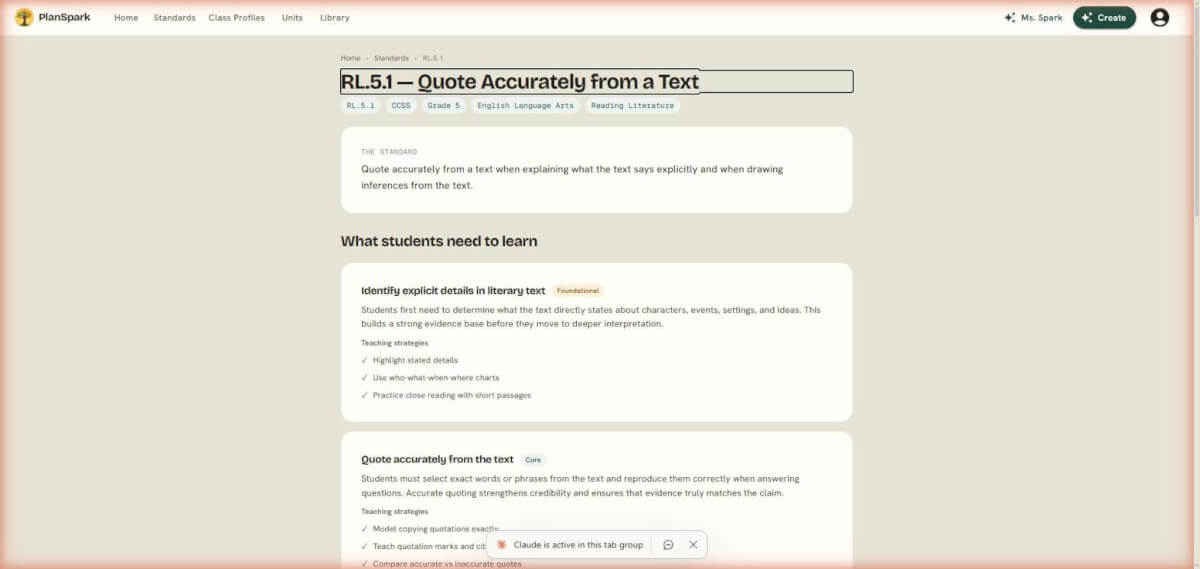
If you want a quick standards reference to keep beside you while planning, PlanSpark offers both an in-app Standards Unpacker and a free RL.5.1 standard breakdown you can use right away.
What RL.5.1 Really Means in Teacher-Friendly Language
Here’s the official work of RL.5.1 in everyday classroom terms:
- Quote accurately from a text means students pull the exact words the author wrote, not a fuzzy retelling or a partly remembered line.
- Explain what the text says explicitly means students can point to details that are directly stated.
- Draw inferences from the text means students read between the lines and make a reasonable idea based on evidence.
- Support inferences with exact evidence means they don’t just say what they think. They show which words, actions, or details led them there.
In short, RL.5.1 is not just “find the answer in the book.” It’s “make a claim, choose the right quote, and explain how the quote proves the claim.” That last part is where many of our fifth graders need the most support.
What Changes from Fourth Grade to Fifth Grade?
By fifth grade, we’re asking for more precision and more explanation.
In fourth grade, students often:
- Refer to details and examples in a text
- Answer questions using evidence
- Begin explaining ideas with support
In fifth grade, students need to:
- Quote accurately, not just mention a detail
- Use longer or more specific excerpts when needed
- Tie the quote directly to the claim
- Differentiate between what the text states and what they infer
That means our instruction has to shift too. We can’t stop at “Find a line that matches.” We need to teach students how to select a precise quote and then explain why that quote is strong evidence.
A helpful way to say it to students is this: Fourth grade often asked you to find evidence. Fifth grade asks you to use evidence carefully.
A Simple 3-Part Breakdown for Teaching RL.5.1
When I teach this standard, I keep it in three moves:
- Make the claim. What does the text say, or what can we infer?
- Quote the text accurately. Which exact words support that claim?
- Explain the connection. How does that quote prove the claim?
This keeps students from treating quotation as the finish line. The quote is the middle step, not the final answer.
Move 1: Make the claim
Start small. Ask students to name one thing the text says clearly or one inference they can make.
Examples:
- Explicit claim: The character is late for school.
- Inference: The character is nervous about what will happen at school.
Students need to know whether they are naming something directly stated or inferred. That distinction matters in RL.5.1.
Move 2: Quote the text accurately
This is where we teach precision. A good quote should be:
- Exact
- Relevant
- Complete enough to make sense
- Not longer than necessary
That means we model the difference between a weak quote and a strong one.
Weak: “He ran.”
Stronger: “Marcus sprinted down the block, clutching his backpack and glancing at the school clock above the doors.”
The second quote gives students much more to work with. It supports both explicit understanding and possible inferences.
Move 3: Explain how the quote proves the point
This is the step students often skip. They write a claim, drop in a quote, and assume the evidence speaks for itself. But our job is to help them build the bridge between evidence and thinking.
We can model that bridge with language like:
- This quote shows...
- The words “___” suggest...
- This proves that...
- From this detail, we can infer...
- The author’s description helps the reader understand...
When students learn to explain the “why,” their responses get much stronger very quickly.
Before-and-After Student Responses for RL.5.1
Let’s use a simple inference prompt:
Prompt: What can you infer about how Elena feels before the performance? Use evidence from the text.
Text detail: “Elena pressed her music folder tightly against her chest and read the first line of the song three times before stepping onto the stage.”
Before
Elena is nervous. “Elena pressed her music folder tightly against her chest.”
This response is headed in the right direction, but it’s incomplete. The student gives an inference and a quote, but the explanation is missing. We don’t yet know why that line proves nervousness.
After
Elena is nervous before the performance. The text says, “Elena pressed her music folder tightly against her chest and read the first line of the song three times before stepping onto the stage.” This shows she is anxious because she is holding the folder tightly and rereading the lyrics again and again, which suggests she is worried about making a mistake.
Now we see all three parts: claim, accurate quote, and explanation. That’s the heart of RL.5.1.
Sentence Stems That Help Students Move Beyond Copying
When students are stuck, sentence stems can do a lot of heavy lifting. The key is to choose stems that push explanation, not just quotation.
For explicit understanding
- The text clearly states, “___.” This means...
- According to the passage, “___.” This shows that...
- One detail that directly tells us this is “___.”
For inferences
- I can infer that ___ because the text says, “___.”
- The words “___” suggest that...
- This detail helps me understand that...
- From the quote “___,” we can tell...
For explaining why the quote matters
- This proves the point because...
- This is important because...
- The author includes this detail to show...
- This evidence supports my inference by showing...
One small tip from experience: don’t post twenty stems at once. Pick three or four, model them repeatedly, and let students use the same language until it becomes natural.
Classroom Routines That Make RL.5.1 Stick
1. Highlight the claim in one color and the evidence in another
This sounds simple because it is, and it works. When students color-code the claim and the quote, they begin to see whether both parts are actually present. Add a third color for the explanation, and suddenly they can check whether they’ve built a complete response.
2. Use “What it says” and “What I can infer” charts
Fold paper into two columns:
- What the text says directly
- What I can infer from those details
This helps students separate explicit information from inference, which keeps responses more accurate.
3. Practice quote selection, not just quote insertion
Give students three possible quotes and ask: Which one is the strongest evidence, and why? This teaches judgment. Students learn that not every quote is equally helpful.
4. Teach short constructed responses in layers
Try this progression over several days:
- Day 1: Write only the claim
- Day 2: Add an accurate quote
- Day 3: Add the explanation
- Day 4: Put all three together
This is especially useful for students who shut down when the whole task appears at once.
5. Model “good enough” quote length
Some fifth graders copy half the page. Others choose two words and call it evidence. We need to show both extremes and think aloud about why a quote is too long, too short, or just right.
Mini-Lesson Language You Can Use Tomorrow
Here’s a quick teaching script you can adapt:
Readers, today we’re working on RL.5.1. That means we are going to make a claim, quote the text accurately, and explain how the quote supports our thinking. A quote by itself is not a full answer. We have to tell why that evidence matters.
Watch me. My claim is that the character is worried. Now I need the exact words from the text. I’m choosing this sentence because it gives me more than an action; it shows a pattern of behavior. Now I ask myself, why does this quote prove worry? I notice the character repeats the line three times. That suggests nervousness, because people often repeat something when they’re afraid of making a mistake.
This kind of brief, repeated think-aloud goes a long way.
Supporting Different Learners with RL.5.1
For students who need more support
- Provide a claim and let them find the quote
- Provide the quote and let them explain it orally first
- Use sentence frames with one blank at a time
- Let students annotate the exact words in the quote that matter most
For students ready for a challenge
- Ask them to compare two quotes and choose the stronger evidence
- Have them support one inference with more than one piece of evidence
- Prompt them to explain why a weak quote does not fully support a claim
Upper-elementary classrooms always include a wide range of readers and writers. RL.5.1 works best when we scaffold the thinking, not water down the task.
Planning Questions to Keep RL.5.1 Instruction Focused
As we plan, it helps to ask:
- Am I asking students to find evidence, explain evidence, or both?
- Will the passage support explicit understanding, inference, or both?
- Have I modeled how to choose the best quote, not just any quote?
- Do students have language supports for explaining why the quote matters?
If you want help turning any story, excerpt, or read-aloud into stronger evidence-based questions, PlanSpark can generate text-dependent questions for any passage you are using. That can save a lot of planning time when you want students practicing RL.5.1 with the texts already in your unit.
Using Standards Tools to Plan RL.5.1 More Clearly
Sometimes the hardest part of teaching a standard is simply pinning down what it expects and what it doesn’t. If you want a cleaner planning path, the in-app Standards Unpacker can help break standards into teachable skills, and the free RL.5.1 standard breakdown is a handy reference when you’re mapping lessons, small groups, or assessments.
Those tools are especially useful when we’re trying to distinguish the three pieces of this standard: quoting accurately, understanding explicit meaning, and supporting inferences with evidence.
Final Thoughts on Teaching RL.5.1
RL.5.1 asks our fifth graders to be more precise, more thoughtful, and more accountable to the text. That’s big work, but it’s very teachable when we slow it down: make the claim, quote accurately, and explain the connection. Once students understand that a quote is not the answer by itself, their reading responses become much stronger.
If your students are still copying and stopping, don’t panic. That usually means they need more modeling and clearer language for the explanation step. Start with one short passage, one strong quote, and one sentence stem that helps them say why the evidence proves the point. Small moves add up fast.
And if you’re planning your next lesson on RL.5.1, take a look at the free RL.5.1 standard breakdown, explore the Standards Unpacker, and try generating text-dependent questions for the passage already on your desk. We all teach this standard a little differently, but the goal is the same: helping students support their thinking with words the text actually gives them.