
By the middle of second grade, most of us can spot the pattern right away: a student solves 8 + 7 by counting on fingers, then does 9 + 6 the same way, then 13 - 5 by counting backward one number at a time. They may get there eventually, but it is slow, fragile, and exhausting. That is exactly why 2.OA.B.2 matters so much. This standard is not asking children to race through facts. It is asking them to become accurate, flexible, and efficient with addition and subtraction within 20.
If we want students to move from counting on for everything to actually knowing their facts, we need more than drill. We need a clear sequence of strategies, strong number relationships, and a short daily routine that gives kids repeated success. In this post, we will unpack what 2.OA.B.2 really expects, where students commonly stall, and how to teach toward true fluency in a way that fits real second-grade classrooms.
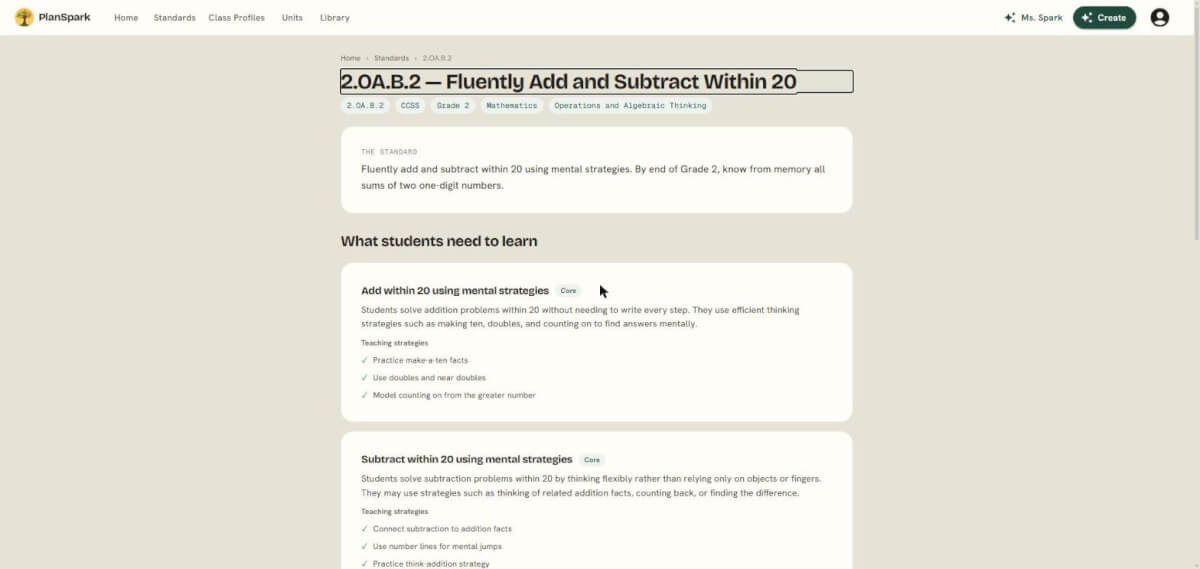
If you want the language of the standard broken down for planning, you can use PlanSpark's Standards Unpacker or browse the free Standards Unpacker. For this specific standard, here is the direct 2.OA.B.2 standard breakdown.
What 2.OA.B.2 Actually Means
The full standard says that second graders should fluently add and subtract within 20 using mental strategies, and by the end of Grade 2, know from memory all sums of two one-digit numbers.
There are three phrases worth slowing down to unpack in 2.OA.B.2:
- Fluently does not mean “fast at any cost.” In elementary math, fluency means accurate, flexible, and efficient.
- Using mental strategies means students are solving through number relationships, not relying on fingers for every problem.
- Know from memory is the result of strategy-based work. Memory grows out of understanding.
That last part is important. We do not skip strategies and jump straight to timed tests. Students learn facts by using sensible strategies over and over until those facts become familiar and automatic.
What fluency looks like in a second-grade classroom
A fluent student might solve:
- 8 + 7 by thinking, “8 and 2 make 10, so 8 + 7 is 10 + 5 = 15.”
- 6 + 6 as a known double.
- 6 + 7 by using a near double: “6 + 6 is 12, so 6 + 7 is 13.”
- 14 - 6 by thinking of the related fact, “6 + 8 = 14, so 14 - 6 = 8.”
Notice what these examples have in common: the student is not counting each quantity by ones. They are using structure.
The Mental Strategies 2.OA.B.2 Expects
When we plan for 2.OA.B.2, it helps to be crystal clear about which strategies deserve daily attention. The standard points us toward core mental strategies that help students organize facts into manageable groups.
1. Making ten
This is one of the biggest bridges to fluency. Students learn to decompose one addend to make a ten with the other.
Examples:
- 8 + 5 = 8 + 2 + 3 = 10 + 3 = 13
- 9 + 6 = 9 + 1 + 5 = 10 + 5 = 15
For subtraction, students can use ten as a friendly number too:
- 13 - 5 can become 13 - 3 - 2 = 10 - 2 = 8
- 15 - 6 can be thought of as “How far from 6 to 15?”
Instructional tip: Use ten-frames and number bonds first, then move to quick sketches, then mental images. We want students to see ten before we expect them to reason with ten mentally.
2. Doubles and near doubles
Doubles are often the first facts students truly own: 3 + 3, 4 + 4, 5 + 5, and so on. Near doubles build naturally from there.
Examples:
- 7 + 7 = 14
- 7 + 8 is one more than 7 + 7, so 15
- 6 + 5 is one less than 6 + 6, so 11
These are efficient because they reduce the number of facts students need to memorize individually. Instead of treating every sum as brand-new, students connect unknown facts to known facts.
3. Related facts and fact families
Addition and subtraction should not live in separate boxes. Students need to see that if they know one equation, they can use it to solve others.
Examples:
- If 8 + 4 = 12, then 4 + 8 = 12
- If 8 + 4 = 12, then 12 - 8 = 4
- If 8 + 4 = 12, then 12 - 4 = 8
This kind of reasoning is especially helpful for subtraction facts. Many students who labor through subtraction become much more confident when they learn to lean on the addition fact they already know.
4. Using known facts to solve unknown facts
Some students are ready to use broader patterns, such as:
- Adding 9 by making ten
- Using commutative reasoning: if 3 + 8 is hard, try 8 + 3
- Using “one more” or “one less” from a known fact
These strategies all support the same goal: helping students stop treating facts as isolated tasks.
Where Students Usually Stall: Counting On for Everything
The most common roadblock in 2.OA.B.2 is not that students know nothing. It is that they know one strategy too well: counting on.
Counting on is a useful early strategy. We want students to use it before they are ready for more advanced reasoning. But when counting on becomes the only tool, progress slows down.
Here is what that stall often looks like:
- Students solve nearly every addition fact by starting with the larger number and counting up by ones.
- Students solve subtraction by counting backward, often making errors around teen numbers.
- Students cannot explain relationships like doubles or make-ten combinations.
- Students seem busy and serious during practice but do not retain facts over time.
Why does this happen? Because counting on feels safe. It works often enough that students stick with it, even when it is inefficient. Our job is to make better strategies visible, useful, and practiced enough that students trust them.
A quick teacher move that helps
When a child counts on for 8 + 7, instead of saying, “Don’t count,” try asking:
- “Do you know a double that is close?”
- “Could you make a ten?”
- “Is there a fact in this problem that already feels familiar?”
We are not just correcting. We are coaching students toward a different path.
A Teaching Sequence That Gets Kids From Counting On to Knowing
Students rarely become fluent by accident. A strong sequence matters. Here is a practical pathway for the middle of the year.
Step 1: Build and name number relationships
Before expecting mental fluency, spend time on the big relationships underneath the facts:
- Partners that make 10
- Doubles
- One more, one less
- Part-part-whole within 20
Use ten-frames, linking cubes, rekenreks, and quick images. Keep the focus on noticing patterns, not just getting answers.
Step 2: Model one strategy at a time
Give each strategy its own spotlight for several days. For example:
- Introduce making ten with visuals.
- Practice sorting problems that fit the strategy.
- Compare making ten to counting on.
- Ask students to explain why the strategy works.
This is where strategy-specific practice pays off. If you want ready-to-use pages focused on make ten, doubles, or related facts, you can create them with PlanSpark's Worksheet Generator. Generating fact-practice worksheets by strategy makes it much easier to match the work to what students are currently learning.
Step 3: Move from concrete to visual to mental
We often rush past representation too quickly. Many second graders still need to:
- Build with counters or cubes
- See the strategy on a ten-frame or number bond
- Sketch it quickly
- Then solve mentally
If students are still dependent on manipulatives in January, that is not failure. It is information. We can keep nudging them toward more efficient representations.
Step 4: Mix strategies and discuss choices
Once students know several strategies, stop cueing one every time. Ask, “Which strategy fits this problem best?” That question builds flexibility, which is a major part of fluency.
For example, compare:
- 8 + 2
- 8 + 8
- 8 + 9
- 13 - 8
Each problem invites a different efficient approach.
Step 5: Practice for retrieval, not just exposure
Students need short, frequent opportunities to recall facts after strategy instruction. Think minutes, not marathon sessions. The goal is repeated successful retrieval connected to understanding.
A 10-Minute Daily Routine That Fixes the Stall
If your class is stuck in counting-on land, a simple daily routine can make a real difference. Here is one we can use right away.
Minute 1-2: Strategy warm-up
Flash a quick visual and ask, “What do you notice?” Examples:
- A ten-frame showing 9 and 4 more
- A double such as 6 + 6
- A number bond for 10 and 7
Keep it oral and brisk.
Minute 3-4: Targeted fact strings
Present 3 to 5 related equations designed around one strategy:
- 6 + 6, 6 + 7, 6 + 8
- 9 + 1, 9 + 3, 9 + 6
- 8 + 5, 13 - 5, 13 - 8
Ask, “How did one fact help you with the next?”
Minute 5-7: Partner talk
Students solve two problems and explain their strategies to a partner using sentence frames:
- “I knew ___, so I solved ___.”
- “I made a ten by ___.”
- “I used a near double because ___.”
Explanation strengthens retention.
Minute 8-10: Quick retrieval check
Give 4 to 6 problems from familiar strategy sets. Keep the tone low-pressure. We are looking for growth over time, not a high-stakes score.
This routine works because it blends strategy instruction, discussion, and retrieval in a short block teachers can actually sustain.
What to Listen for During Student Talk
One of the best formative assessments for 2.OA.B.2 is simply listening to how students explain. We want to hear language like:
- “I made a ten.”
- “I used a double.”
- “That fact is one more than a double.”
- “I used the addition fact to solve the subtraction fact.”
If we mostly hear, “I counted,” that tells us students need more modeling, more visual support, and more chances to compare strategies.
Red flags to watch for
- Students cannot recognize combinations that make 10.
- Students know doubles in isolation but do not apply them to near doubles.
- Students treat subtraction as a separate skill and do not use related addition facts.
- Students are accurate only when they have lots of time and fingers available.
Those are teachable issues, not fixed limitations. They tell us exactly where to aim next.
Planning Midyear Support for Different Learners
In every second-grade room, we will have a spread of readiness.
Students still relying heavily on counting on
Focus on:
- Ten-frame work
- Doubles games
- Explicit comparison of counting on versus making ten
- Small-group practice with just one strategy family at a time
Students who know some facts but use strategies inconsistently
Focus on:
- Mixed practice where they choose the strategy
- Partner explanations
- Fact sorts by “best strategy”
Students who are already fairly fluent
Focus on:
- Explaining multiple strategies for the same problem
- Helping classmates justify reasoning
- Applying fact fluency to two-step word problems and larger-number computation
That range is normal. The key is keeping strategy instruction alive for everyone while adjusting the level of support.
Final Thoughts on 2.OA.B.2
2.OA.B.2 is about much more than speed drills. It is about helping children develop dependable number sense so they can solve within 20 accurately, flexibly, and efficiently. When students get stuck counting on for every problem, the answer is not more pressure. It is better instruction: making ten, doubles and near doubles, related facts, and a daily routine that gives those strategies room to stick.
If you are planning midyear instruction, start with a clear breakdown of the standard using PlanSpark's Standards Unpacker, explore the free Standards Unpacker, and take a look at the specific 2.OA.B.2 standard breakdown. Then build practice that matches the strategy your students need most. If you want quick, targeted pages for doubles, make ten, or related facts, create them with PlanSpark's Worksheet Generator.
We all know fact fluency can feel like a long middle-of-the-year climb. But when we teach the relationships underneath the facts, our students do get there. One strong strategy at a time, they move from counting on to knowing.