
We’ve all had that moment: we finish teaching a lesson sequence, build what looks like a solid quiz, and then realize the results don’t tell us what students actually know. Maybe the questions were too easy. Maybe they sounded rigorous but really just asked for recall. Maybe the standard asked students to analyze, justify, or solve, and our items only asked them to identify. If you’ve been there, you’re in good company.
Knowing how to write assessment questions that truly match a standard is one of the most important parts of classroom assessment. When our items line up to the skill and cognitive demand we taught, we get cleaner data, make better instructional decisions, and avoid reteaching the wrong thing. The good news is that this work gets much easier when we use a simple process: unpack the standard, identify the thinking level, choose the right item type, and check whether the question measures the skill instead of just sounding difficult.
In this post, we’ll walk through a practical way to go from standard to strong assessment item, with examples across grade levels and a before-and-after revision you can use right away.
Start with the standard, not the question format
When we’re in a hurry, it’s tempting to start with the test format: multiple choice, short answer, matching, true/false. But strong classroom assessment starts with the standard itself. Before we write anything, we need to ask:
- What is the actual skill students must demonstrate?
- What knowledge do they need in order to show that skill?
- What level of thinking does the standard require?
- What did we ask students to do during instruction?
That last question matters. If students spent the week comparing strategies, explaining reasoning, and defending claims, then a quiz full of simple recall items won’t tell us whether they met the standard.
A helpful first step is to break the standard into parts. You can do that yourself, or use PlanSpark's Standards Unpacker as a starting point to identify the core skill, concepts, and academic language. Once the standard is unpacked, it’s much easier to write items that measure the right target.
A quick example of unpacking
Let’s take a middle school ELA standard such as: Cite textual evidence to support analysis of what the text says explicitly as well as inferences drawn from the text.
Unpacked, that might look like this:
- Skill: cite evidence to support analysis
- Content: explicit details and inferred meaning from a text
- Cognitive demand: analyze and support thinking, not just locate a quote
That tells us right away that a question asking students to define “textual evidence” would miss the target. It may assess vocabulary, but not the standard.
How to write assessment questions by matching cognitive demand
If we want to know how to write assessment questions well, we have to pay attention to cognitive demand. In plain language, that means matching the level of thinking in the question to the level of thinking in the standard and instruction.
Here’s the key idea: a question can look hard without actually measuring deep thinking. Long reading passages, tricky wording, or unfamiliar contexts can make an item feel rigorous, but rigor comes from the thinking students must do.
Common mismatches to watch for
- The standard asks for analysis, but the item asks for recall.
Example: Students are supposed to compare themes, but the question only asks them to identify the setting. - The standard asks for explanation, but the item only asks for selection.
Example: Students choose an answer from four options, but never justify why it is correct. - The standard asks for solving or modeling, but the item asks for vocabulary.
Example: A math standard focuses on representing proportional relationships, but the assessment asks students to define “proportion.” - The item uses hard words or a complicated format, but the task itself is shallow.
That’s the classic “looks rigorous but tests recall” problem.
A simple cognitive-demand check
Before finalizing an item, ask:
- What thinking verb is implied by the standard? Analyze? Explain? Solve? Compare? Revise?
- What evidence would show that a student can do that?
- Does this item require students to produce that evidence?
If the answer to #3 is no, revise the item.
Choose item types that fit the skill
Not every standard needs a long constructed response, and not every quick check should be multiple choice. The best item type depends on what students need to show.
When multiple-choice works well
Multiple-choice questions can be very useful when written carefully. They work best when students must distinguish between strong and weak reasoning, identify the best evidence, select the most accurate representation, or apply a skill to a new example.
Good uses include:
- Grades 3-12 ELA: choosing the best evidence to support a claim
- Math: identifying which strategy correctly solves a problem
- Science: selecting the explanation best supported by data
- Social studies: choosing the claim most consistent with a source
To keep multiple-choice items aligned, avoid distractors that are silly or obviously wrong. Make students think.
When short answer is the better choice
Short answer works well when students need to explain briefly, show a step, cite evidence, or justify an answer in one or two sentences. This is often the sweet spot for classroom quizzes because it gives us more information than multiple choice without the grading load of a full essay.
Good uses include:
- Explaining how they solved a grade 5 fraction problem
- Citing one sentence from a passage and explaining how it supports an inference
- Describing a cause-and-effect relationship in a social studies source
When extended response is necessary
If the standard requires sustained analysis, argument writing, modeling, or multi-step problem solving, students need enough space to demonstrate that. In those cases, an extended response or performance task is usually the right fit.
Good uses include:
- Upper elementary and middle school ELA: comparing themes across two texts with evidence
- High school science: analyzing data and defending a conclusion
- Math: solving a multistep modeling task and explaining the reasoning
When matching, true/false, and fill-in-the-blank are limited
These formats can be useful for checking foundational knowledge, vocabulary, or prerequisite facts. They’re not wrong. They just usually measure lower-level recall unless we’re very intentional. If the standard is skill-heavy, these formats should play a small supporting role, not carry the whole assessment.
A before-and-after example: weak vs. aligned
Let’s look at what this sounds like in practice.
Standard
Grade 5 ELA: Explain how a series of chapters, scenes, or stanzas fits together to provide the overall structure of a text.
Weak item
Question: What is a stanza?
Why it’s weak: This checks vocabulary knowledge, not the skill in the standard. A student could answer correctly and still be unable to explain how parts of a text contribute to overall structure.
Better, aligned item
Question: Read the poem. How does the final stanza contribute to the overall structure of the poem? Use details from earlier stanzas in your explanation.
Why it’s aligned: Students must explain how one part fits into the whole and support their thinking with text details. That matches both the skill and the cognitive demand.
Even stronger if you want a two-part item
- Which statement best explains the role of the final stanza in the poem?
- What detail from an earlier stanza best supports your answer?
This format can work well if you want a more scaffolded item while still measuring the standard.
What “looks rigorous but tests recall” often sounds like
Sometimes the problem isn’t the topic. It’s the task. Here are a few red flags.
- Students only identify a term when the standard asks them to use it.
- Students choose a correct answer but never explain their reasoning.
- The reading level or directions are complicated, but the thinking is simple.
- The item focuses on isolated facts from instruction rather than transfer of the skill.
For example, in high school biology, a standard may ask students to analyze how environmental changes affect population dynamics. A weak item might ask students to define “carrying capacity.” An aligned item might present a graph and ask students to explain how a drought changed the population trend and justify the claim with evidence from the data.
That’s a good litmus test for rigor: are students doing the thinking the standard requires, or just naming something they heard in class?
A practical process for writing stronger classroom assessment items
1. Rewrite the standard in teacher-friendly language
Finish the sentence: Students should be able to… That helps clarify the skill.
2. Identify the evidence of mastery
What would a proficient student say, write, solve, draw, or select? Be specific.
3. Match the item type to that evidence
If mastery requires explanation, build in explanation. If it requires modeling, use a task that includes modeling.
4. Write the item with clear, direct language
We’re assessing the standard, not students’ ability to untangle confusing directions. Keep wording simple unless language complexity is part of the target.
5. Review for alignment, not just difficulty
Ask: “Does this question truly measure the intended skill?” not just “Does this seem challenging?”
6. Check the distractors or scoring criteria
For selected-response items, make sure wrong answers reflect real misconceptions. For constructed response, define what counts as success before giving the assessment.
7. Compare the assessment to instruction
If students practiced analyzing mentor texts, don’t assess only definitions. If they solved real-world ratio problems, don’t assess only procedural steps in isolation.
Subject-specific snapshots
Elementary math
If a grade 4 standard asks students to compare fractions, don’t stop at “Which fraction is greater?” Consider adding, “Explain how you know using a visual model or benchmark fraction.” That gives us evidence of conceptual understanding.
Middle school science
If students must interpret data, include a table, graph, or observation set. Ask them to make a claim and support it, rather than recall a definition from notes.
High school social studies
If the standard emphasizes sourcing and argument, use short primary-source excerpts and ask students to evaluate which source best supports a historical claim and why.
Use tools as a starting draft, not a substitute for teacher judgment
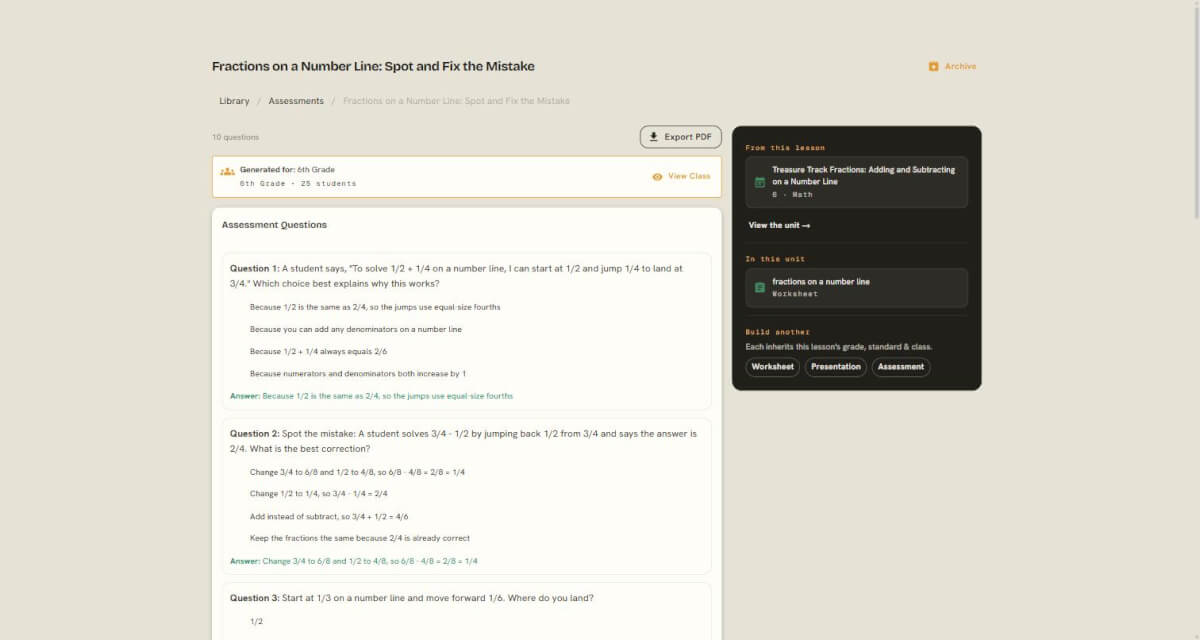
Sometimes we need a head start, especially when we’re building multiple versions, creating common assessments, or trying to cover several standards before Friday. That’s where a tool can help. PlanSpark's Assessment Generator can create standard-aligned item drafts to save time and give us a starting point. The key word is starting. We still want to review each item for cognitive demand, clarity, and fit for our students.
That combination tends to work best: let the tool help with the first draft, then apply our classroom knowledge to make sure the assessment matches what we taught and what the standard actually expects.
Final thoughts on how to write assessment questions well
At the heart of how to write assessment questions is a simple principle: assess the skill, not just the topic. When we start with the standard, match the cognitive demand, and choose item types that let students show real thinking, our assessments become more useful and more fair.
If you’re revising your own quizzes and tests this year, start small. Take one standard, unpack it, and rewrite one weak item into a better-aligned version. That one shift can tell you much more about student learning. And if you want a draft to work from, PlanSpark can help you generate standards-based items quickly so you can spend your energy refining what matters most.
We don’t need trickier questions. We need clearer ones that measure the learning target. That’s the kind of assessment data we can actually use on Monday morning.