
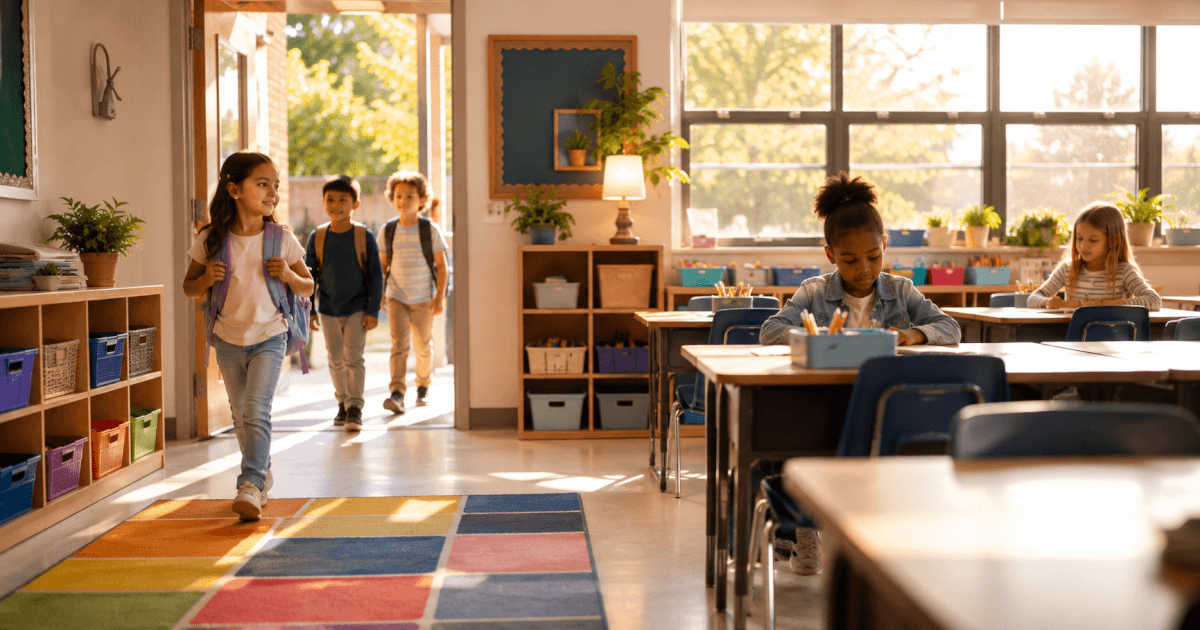
If you’ve ever reached October feeling like you’re spending more energy on passing out notebooks, getting students quiet, and moving from the carpet to desks than on the lesson itself, you’re not alone. Most of us have learned this the hard way: strong classroom routines and procedures are not extra work at the beginning of the year—they are the work that makes everything else easier.
In the first two weeks, we do not need to teach every possible routine under the sun. We need to teach the few that students will use all day, every day, and practice them until they become automatic. When those routines are clear, calm, and consistent, we spend less time redirecting and more time teaching reading, math, science, writing, and everything else we actually came here to do.
Let’s walk through the core routines worth over-teaching early: entry, transitions, materials, and your attention signal. I’ll also share simple ways to practice them so they stick, with examples for K-2, 3-5, and middle grades.
Why classroom routines and procedures matter so much early on
Students feel safer when they know what to do. Teachers feel calmer when they don’t have to narrate every next step. That’s really the heart of it.
Well-taught routines help us:
- Reduce confusion and off-task behavior
- Protect instructional minutes
- Support students who need predictability
- Make expectations fair and clear for everyone
- Create a classroom that feels steady, not chaotic
And here’s the reassuring part: routines do not need to be fancy. They need to be teachable, observable, and repeatable.
The four routines worth over-teaching in the first two weeks
If we try to teach twenty procedures at once, students remember very little. I’d rather see us choose a short list and teach it well.
1. Entry routine
The entry routine sets the tone for the whole class period or school day. If students know exactly how to enter, what to do with their belongings, and how to start, you eliminate a lot of drift.
A strong entry routine usually answers these questions:
- How do students enter the room?
- Where do backpacks, folders, lunch boxes, or devices go?
- What should they do first?
- When may they talk, and at what level?
- What do they do if they arrive late?
Example for K-2: Students enter, hang backpacks, put folders in the bin, choose lunch, sit on the carpet, and begin the morning picture prompt.
Example for grades 3-5: Students enter, take out math journals, check the board for the warm-up, and begin independently within two minutes.
Example for grades 6-8: Students enter, pick up the day’s handout from a side table, sit in assigned seats, and respond to the bell ringer posted on the screen.
Keep the number of steps manageable. Three to five steps is usually enough.
2. Transition routine
Transitions eat up more time than we think. Going from mini-lesson to independent work, desk groups to carpet, science lab to cleanup—those little in-between moments can either stay smooth or unravel quickly.
For each common transition, decide:
- What signal tells students it is time to move?
- What should movement look and sound like?
- How long should it take?
- What should students do when they arrive at the next place?
We do not need a different procedure for every tiny shift. We do need one or two clear transition patterns students can use over and over.
K-2 example: “When I ring the chime, freeze, look, listen. When I say ‘Go,’ walk to your table spot and put both hands on your work mat.”
3-5 example: “You have 30 seconds to move from tables to the meeting area with your notebook and pencil. Sit in your assigned spot and show me you’re ready by opening to the marked page.”
6-8 example: “When the timer starts, finish your sentence, close laptops halfway, move to lab partners, and begin the first instruction on the slide.”
3. Materials routine
A surprising amount of class time disappears into pencils, paper, glue sticks, notebooks, and chargers. A materials routine prevents the same interruptions all day long.
Think through your high-frequency materials questions:
- How are papers passed out and turned in?
- Where do students get missing work?
- What happens when someone needs a pencil?
- How are shared supplies picked up, used, and returned?
- What is the cleanup procedure?
One of the simplest ways to strengthen this routine is to remove unnecessary decision-making. Label bins. Assign table jobs. Keep turn-in spots consistent. Use the same system long enough for it to become habit.
If you want help mapping out these details inside your instruction, PlanSpark's Lesson Plan Generator can help you build lessons with clear openings, transitions, and materials planning already in mind.
4. Attention signal
Every classroom needs a reliable way to bring the group back together. Your attention signal should be simple, quick, and used consistently.
That might be:
- A chime or bell
- “Class, class” / “Yes, yes”
- Hand raised
- Call and response
- A countdown
The specific signal matters less than what students are expected to do when they hear or see it. Be explicit. For example: “When you hear the chime, stop, put materials down, face me, and stay silent.”
Then teach it like you would any other skill.
How to teach classroom routines and procedures so they actually stick
Here is where many of us get tripped up. We explain a routine once, maybe twice, and then feel frustrated when students do not follow it independently. But routines stick through instruction and repetition, not through reminders alone.
Use the “I do, we do, you do” approach
- Explain it clearly. Keep directions short and concrete.
- Model it. Show students exactly what it looks like and sounds like.
- Practice it together. Guide the whole class through it.
- Repeat it. Do it again, especially if it was sloppy the first time.
- Debrief briefly. Name what went well and what to fix.
This is not babying students. This is teaching.
Practice at calm times, not just after mistakes
One of the best moves in the first two weeks is to schedule practice when everyone is regulated and fresh. Don’t wait until a transition goes badly. Build in a few minutes to rehearse.
You might say:
- “Let’s practice entering the room one more time so tomorrow feels easy.”
- “We’re going to reset and try that materials cleanup again.”
- “I want to shave 20 seconds off that transition. Let’s see if we can do it smoothly.”
Students usually respond well when the tone is matter-of-fact instead of irritated.
Teach the why in one sentence
Students do better when they understand the purpose. We do not need a long speech. A single sentence is enough.
For example:
- “This entry routine helps us start learning right away.”
- “This transition keeps everyone safe and saves our lesson time.”
- “This cleanup procedure helps us find materials tomorrow.”
Make success visible
Especially in the first two weeks, it helps to post or display the steps for major routines. This can be a chart, icons, photos, or a short slide. Primary students may need picture cues. Older students often do fine with a three-step checklist on the board.
Visible cues reduce repeated verbal directions and support students who need that extra layer of structure.
Grade-band examples we can use right away
K-2: Keep it concrete and physical
Younger students benefit from short directions, visual support, and lots of rehearsal.
- Use photos to show “how we line up,” “how we sit on the carpet,” and “how we clean up centers.”
- Practice with narration: “I see Maya pushing in her chair and walking safely.”
- Keep language consistent. Say the same cue the same way each time.
- Use short practice rounds instead of one long explanation.
Sample attention signal routine: “When I clap the pattern, you freeze, put your eyes on me, and keep your voice off.” Practice it three times before you need it in a real lesson.
Grades 3-5: Add independence without adding complexity
Upper elementary students can handle more responsibility, but they still need routine taught explicitly.
- Assign supply jobs by table or row.
- Use timers for transitions.
- Teach what to do when finished early.
- Build one consistent turn-in system for all subjects if possible.
Sample materials routine: One paper manager per table collects and returns notebooks. Absent work goes in a labeled folder. Sharpened pencils live in one cup; dull pencils go in another.
Grades 6-8: Be clear, efficient, and respectful
Middle grades students appreciate routines that feel purposeful, not childish. They still need structure—just delivered in a straightforward way.
- Explain the routine and its purpose briefly.
- Use entry tasks that students can complete independently.
- Teach movement expectations for labs, partner work, and device use.
- Be consistent with consequences and resets when routines slip.
Sample entry routine: “By the bell, be in your seat, materials out, and first response started. If you’re not sure what to do, check the screen and the agenda board.”
Common mistakes to avoid
Even strong teachers can fall into these traps early in the year:
- Teaching too many routines at once. Start with the highest-impact ones.
- Explaining without practicing. Students need rehearsal.
- Changing the system too quickly. Give routines time to settle.
- Talking too much during corrections. Reset, reteach, and try again.
- Assuming older students “should know better.” Every classroom is different, and expectations must be taught.
A simple first-two-weeks plan
If you want a manageable approach, here’s a realistic sequence:
Days 1-3
- Teach and practice entry routine
- Teach and practice attention signal
- Teach one basic transition
- Teach turn-in and pickup procedures
Days 4-7
- Re-practice all four core routines
- Add cleanup procedure
- Add partner or group work transition
- Tighten timing and independence
Days 8-10
- Notice weak spots and reteach only what needs work
- Have students reflect: What helps our class run smoothly?
- Keep praise specific and connected to the routine
That’s enough. We do not need perfection by day ten. We need steady progress and consistency.
Solid routines give us more room for real teaching
This is the payoff. Strong classroom routines and procedures are not about being rigid for the sake of it. They free our brains and our minutes. When students know how to enter, transition, manage materials, and respond to a signal, we can focus on comprehension, number sense, writing conferences, science investigations, and all the rich learning we actually care about.
So if the first two weeks feel repetitive, that’s okay. Repetition now saves us from reteaching all year long. Choose the few routines that matter most, teach them clearly, practice them patiently, and keep your systems steady. Your future self will be grateful.
And if you want a hand organizing lessons with smoother openings and clearer flow, take a look at PlanSpark's Lesson Plan Generator. A little planning around classroom routines and procedures can make the whole year feel lighter.