
If you teach fourth-grade writing, you’ve probably read plenty of opinion pieces that sound something like this: “I think recess should be longer because it is fun. Also, it is good because I like it.” That’s not a motivation problem. That’s a scaffolding problem. W.4.1 asks students to do much more than share a preference. It asks them to state an opinion, support it with reasons, use facts and details as evidence, and organize the whole piece so it actually holds together.
The tricky part, of course, is that many of our students can come up with an opinion and even a reason or two. Where they stall is the next step: moving from a reason to actual evidence. They restate the opinion, repeat the reason, or fall back on “because I like it.” In this post, we’ll unpack W.4.1 in plain language and walk through a practical scaffold that helps fourth graders build stronger opinion writing one sentence at a time.
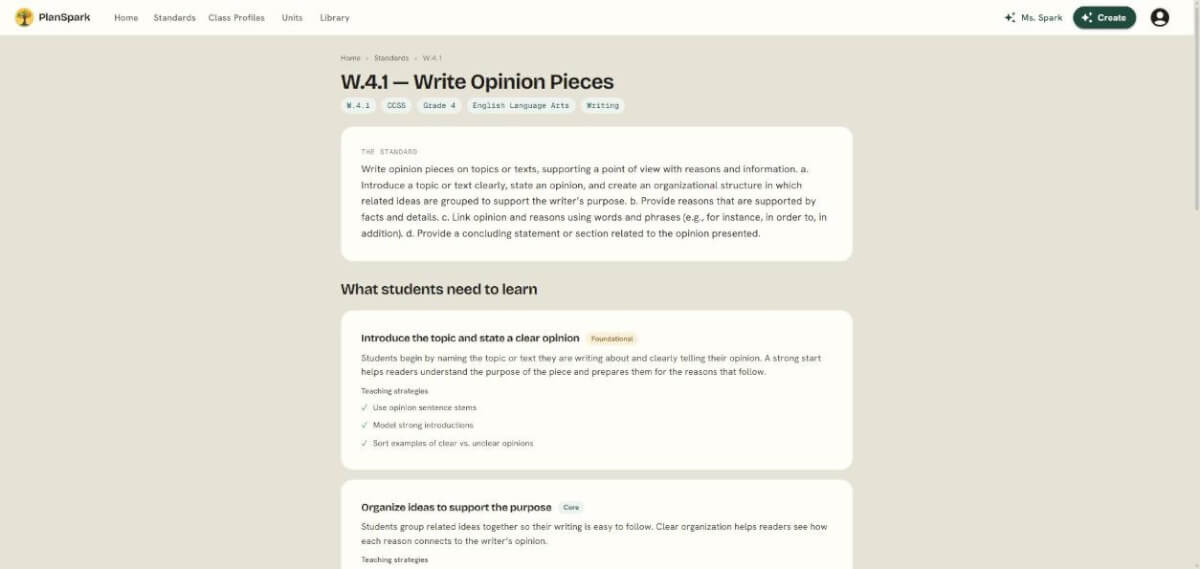
If you want the standard itself broken down into teacher-friendly language, PlanSpark’s W.4.1 standard breakdown is a helpful place to start, and our in-app Standards Unpacker can help us turn the standard into daily teaching moves.
What W.4.1 really asks students to do
In plain language, W.4.1 asks fourth graders to:
- State a clear opinion
- Give reasons that support that opinion
- Support those reasons with facts and details
- Link ideas together with words such as because, for example, also, and therefore
- Write a conclusion that fits the opinion piece
That sounds straightforward on paper, but in the classroom, each part takes explicit instruction.
Here’s the simple version I like to give students:
- Opinion: What do you believe?
- Reason: Why do you believe it?
- Evidence: What facts, examples, details, or information prove that reason?
- Organization: Can your reader follow your thinking from beginning to end?
When we teach it this way, students can hear the difference between a feeling and an argument. That’s an important shift in upper elementary. We are not asking them to sound like lawyers; we are teaching them to explain their thinking clearly and support it in writing.
Where fourth graders usually get stuck: the jump from reason to evidence
Most of us have seen this pattern:
- Opinion: School uniforms should be required.
- Reason: They help students focus.
- “Evidence”: They help students focus because uniforms are good.
That last sentence is not evidence. It’s just the reason repeated in different words.
This is the heart of the instructional challenge in W.4.1. Students often think they are done once they give a reason. But readers need more. We have to teach children that a reason answers why, while evidence answers how do you know or what shows that.
One of the most useful mini-lessons we can teach is this distinction:
- Reason: a supporting idea
- Evidence: the facts, examples, observations, or details that back up the reason
I often model it with sentence frames like these:
- My opinion is ______.
- One reason is ______.
- I know this because ______.
- For example, ______.
- This shows ______.
At first glance, that may seem simple. But for many fourth graders, this structure is exactly what helps them move beyond general statements.
A scaffold that gets students past “because I like it”
When students struggle with evidence, they usually need a tighter bridge between the reason and the proof. Here’s a scaffold that works well in upper-elementary ELA because it breaks the task into manageable thinking steps.
Step 1: Start with a clear opinion
Ask students to make a claim someone could reasonably discuss.
For example:
Our school should add more nonfiction read-alouds.
That’s much stronger than “Nonfiction is nice” or “I like nonfiction.” A solid opinion gives students somewhere to go.
Step 2: Add one reason
Next, students name one reason that supports the opinion.
One reason is that nonfiction read-alouds teach students useful information about the real world.
So far, so good. This is where many students stop.
Step 3: Ask evidence questions
Now we help them develop the reason with question stems that produce evidence instead of restatement. These are the questions I’d put on an anchor chart, conference checklist, or small-group mat:
- What facts show this reason is true?
- What example can you give?
- What happened that proves it?
- What did students learn specifically?
- What details would help the reader picture it?
- How does this reason work in real life?
- Can you name a text, topic, statistic, or classroom example?
- What would a teacher, student, or parent notice?
Notice what these stems do: they push students away from repeating the reason and toward supplying information.
Step 4: Turn the answers into evidence sentences
Once students answer the question stem orally, we help them draft evidence.
For example, when our class listened to a read-aloud about hurricanes, we learned how storms form, why weather warnings matter, and how families prepare safely. These details helped us understand a science topic while practicing listening and note-taking.
Now the reason has support. The paragraph is beginning to sound credible.
Step 5: Explain how the evidence supports the opinion
This final sentence is often overlooked, but it helps students tie their thinking together.
This shows that nonfiction read-alouds are valuable because they build knowledge, not just entertainment.
That explanation sentence helps students connect evidence back to the claim. It also improves organization, which is another important part of W.4.1.
A simple paragraph structure we can teach right away
For many fourth graders, especially early in the year, a repeatable structure helps. Here is one that works well for opinion paragraphs:
- Opinion sentence
- Reason sentence
- Evidence sentence
- Another evidence sentence or example
- Explain-how-it-supports sentence
That does not mean every piece should sound robotic. It means we are giving students a frame sturdy enough to hold their ideas while they are learning the craft.
You might model it like this:
I believe every fourth-grade class should have a daily independent reading time. One reason is that regular reading time helps students become stronger readers. For example, students get to practice reading smoothly and figuring out unfamiliar words in books they can actually read. They also build stamina by staying with a text longer each day. This shows that daily reading time supports reading growth in clear, practical ways.
That paragraph is not fancy, but it is aligned. And aligned writing gives us something concrete to build on.
Weak-to-strong rewrite: showing students the difference
One of the best ways to teach opinion writing is to revise a weak paragraph in front of students. Let’s use a familiar fourth-grade topic.
Weak student paragraph
I think school should have more art because art is good. Art is fun and kids like it. It is important because it is a special class. That is why we need more art.
This student has an opinion and a few attempts at reasons, but there is no real evidence. The ideas are repetitive, and the reader is left asking, “What makes art good for students?”
Stronger rewrite
I think school should have more art classes because art helps students express their ideas in creative ways. For example, students can show their understanding through drawing, painting, and designing projects, even when they struggle to explain their thinking in writing. In art, they also learn skills such as planning, revising, and paying attention to detail. Last semester, our class made posters connected to a social studies unit, and many students included accurate symbols and important facts in their work. This shows that art is not only enjoyable, but also helps students learn and communicate.
When we compare the two versions with students, we can name what changed:
- The opinion became clearer.
- The reason became more specific.
- Evidence was added through examples and classroom details.
- The final sentence explained why the evidence mattered.
That kind of side-by-side analysis helps students see that stronger writing is not about “adding more words.” It is about adding the right kind of support.
Classroom moves that make W.4.1 easier to teach
Use oral rehearsal before drafting
Many students can say evidence before they can write it. Try partner talk with a prompt such as: Your reason is _____. Tell your partner one example that proves it. A quick turn-and-talk often produces stronger sentences than silent drafting alone.
Color-code opinion, reason, and evidence
This is especially helpful for visual learners and students who mix up reasons and examples. Try one color for the opinion, another for reasons, and a third for evidence. If everything ends up the same color, students can immediately see what is missing.
Teach linking words in context
Students need transitions, but not as a random word bank. Teach them by purpose:
- To add a reason: also, another reason, in addition
- To give evidence: for example, for instance, specifically
- To explain: this shows, this proves, because of this
- To conclude: therefore, for these reasons, in conclusion
That keeps transition instruction tied to actual writing moves.
Build a rubric directly from the standard
One of the smartest ways to support independence is to use the language of the standard itself in a student-friendly checklist or rubric. If W.4.1 expects an opinion, reasons, facts and details, linking words, and a conclusion, those should become the categories students check before turning in their work.
A rubric built from the standard’s own language makes self-assessment much more meaningful because students know exactly what they are looking for. If you want a faster way to create one, PlanSpark's Rubrics tool can help us generate rubrics that stay tightly aligned to the writing target.
I’d even recommend having students pause before submission and ask:
- Did I clearly state my opinion?
- Did each reason support my opinion?
- Did I include facts, details, or examples for each reason?
- Did I use linking words to connect my ideas?
- Did I write a conclusion that fits?
Those five questions can improve a draft before it ever reaches our stack.
Planning mini-lessons around the standard
If your students are all over the place with opinion writing, it helps to separate the standard into teachable chunks across several days:
- Day 1: What is an opinion versus a preference?
- Day 2: Writing strong reasons
- Day 3: Finding evidence for a reason
- Day 4: Using linking words to connect ideas
- Day 5: Writing conclusions
- Day 6: Revising with a rubric
This pacing works especially well in grade 4 because it lowers the cognitive load. Students do better when we teach one part deeply, then bring the parts back together.
Why this matters beyond one opinion piece
When we teach students to move from reason to evidence, we are doing more than improving one writing assignment. We are helping them learn how to support an idea, explain their thinking, and communicate with clarity. Those skills show up everywhere: reading responses, science explanations, social studies essays, and classroom discussions.
That’s why W.4.1 is such an important standard. It gives students an early foundation in academic argument: not arguing loudly, but arguing clearly.
If you’re planning your next opinion writing unit, start small. Teach the difference between a reason and evidence. Give students the question stems. Model the weak-to-strong rewrite. Then let them use a rubric before they hand it in.
And if you want a teacher-friendly way to break the standard apart, take a look at PlanSpark’s Standards Unpacker and the free W.4.1 standard breakdown. When we unpack the standard clearly, we can teach it clearly — and our students are far more likely to move past “because I like it” into writing that truly supports an opinion.