
If you teach 5th grade math, you have probably watched a student nod along while reading a fraction, then completely freeze when you say, “So what does 3 divided by 4 equal?” That moment is exactly why 5.NF.B.3 matters. This standard asks students to understand that a fraction is not just two numbers stacked on top of each other. It represents division. And for many students, especially those who are still holding onto the idea that “division makes things smaller” or “fractions are less than one,” that idea can feel like a brain-twister at first.
The good news is that 5.NF.B.3 becomes much more manageable when we teach it through sharing situations, visual models, and lots of plain language. In this post, we’ll unpack what the standard really means, why “3 shared by 4” can be so confusing, and a concrete-to-abstract teaching sequence that helps students make the leap.
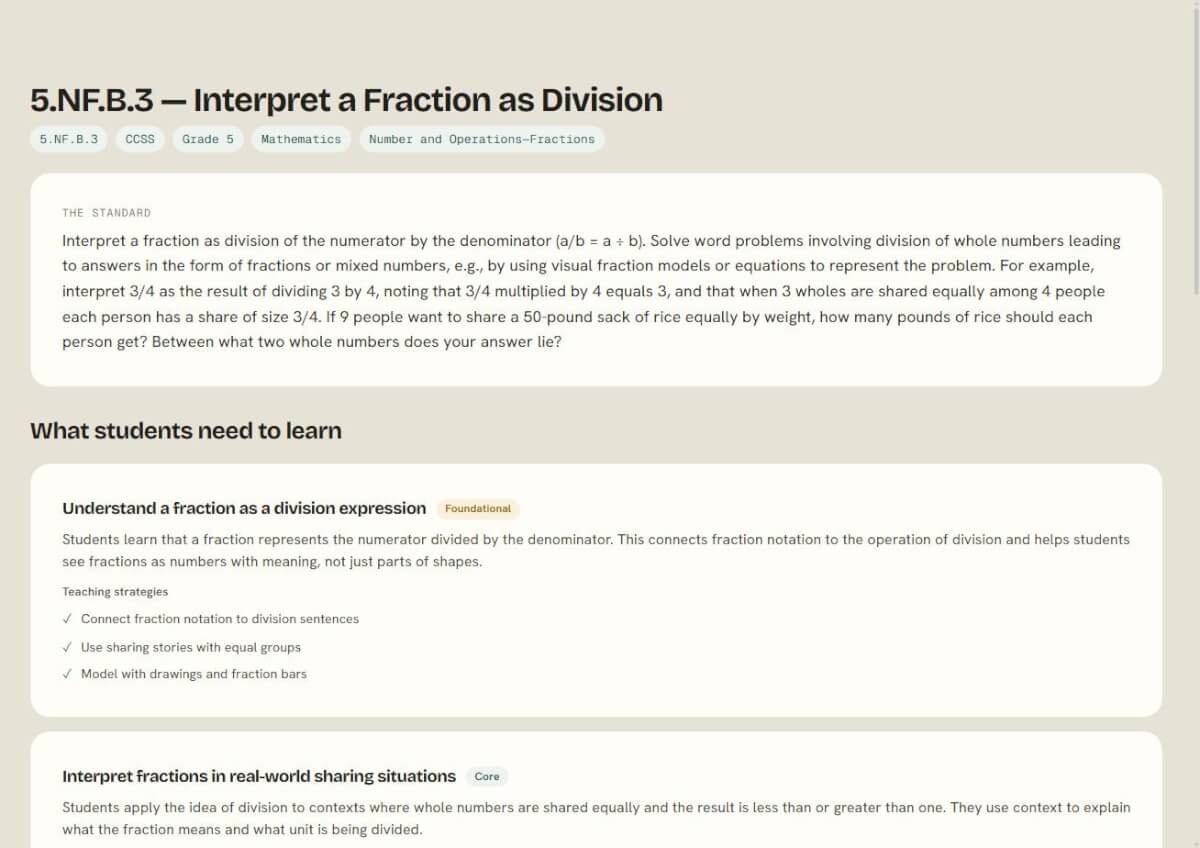
If you want the official language broken down into teacher-friendly steps, take a look at PlanSpark’s Standards Unpacker, the free Standards Unpacker, and this specific 5.NF.B.3 standard breakdown.
What 5.NF.B.3 Actually Means
The standard says students should interpret a fraction as division of the numerator by the denominator. In classroom terms, that means:
3/4 means 3 divided by 4
5/2 means 5 divided by 2
a/b means a shared equally among b groups or people
That sounds simple when we say it quickly. But for students, this is a major conceptual shift. Up to this point, many of them have seen fractions mostly as parts of a whole: one shaded piece out of four, three pieces of a pizza, six tenths on a number line. Now we are asking them to see a fraction as the answer to a division problem.
That means students need to connect three ideas at once:
Division can describe equal sharing.
The quotient does not have to be a whole number.
A fraction is one way to write that quotient.
In other words, 5.NF.B.3 is not just about naming a fraction. It is about interpreting what that fraction means in a real situation.
Why “3 Shared by 4” Breaks Students’ Brains
Let’s be honest: “3 shared by 4” sounds backwards to many 10- and 11-year-olds. They are used to division problems like 12 cookies shared by 4 kids. Nice and tidy. Everyone gets 3 cookies. No problem.
But 3 brownies shared by 4 kids? Now we are in the land of cutting things up, and some students start to panic.
Misconception 1: “You can’t divide 3 by 4 because 4 is bigger.”
This is one of the most common sticking points. Students often think the divisor has to be smaller than the dividend for division to “work.” What they really mean is that they are used to quotients that are whole numbers.
We can respond with concrete context: “You may not have enough brownies to give each student a whole one, but you can still share fairly.” That sentence alone opens the door.
Misconception 2: “A fraction can’t be the answer to division.”
Students may see division and fractions as two separate math topics. They do not yet realize they are deeply connected. This standard helps us merge those ideas.
When we write:
3 ÷ 4 = 3/4
we are not introducing a trick. We are showing two ways to represent the same quantity.
Misconception 3: “Fractions are always less than 1.”
This is another big one, especially when students move from examples like 3/4 to examples like 7/4 or 5/3. If they believe fractions are always “little pieces,” then improper fractions feel wrong.
That is why it helps to teach both kinds of examples. Students need to see that:
3 shared by 4 gives each person less than 1 whole
5 shared by 4 gives each person more than 1 whole
Both are valid. Both are fair shares. Both are fractions as division.
A Concrete-to-Abstract Teaching Sequence for 5.NF.B.3
When this standard clicks, it usually does not happen because we gave a polished explanation. It happens because students have physically or visually worked through enough sharing situations to trust the math. Here is a sequence that works well in upper-elementary classrooms.
Step 1: Start with real sharing contexts
Use food, paper strips, counters, or drawings. Brownies are classic for a reason. Students can picture them, and the equal-sharing context is obvious.
Start with a prompt like:
Three brownies are shared equally among four students. How much does each student get?
Do not begin with the symbolic equation. Let students act it out first.
Draw 3 rectangles for brownies
Label 4 students
Cut each brownie into 4 equal parts
Distribute one fourth from each brownie to each student
Then ask, “How many fourths does each student get?” Students can count: 3 fourths. So each student gets 3/4 of a brownie.
That is the moment to connect it back: 3 brownies ÷ 4 students = 3/4 brownie per student.
Step 2: Use multiple representations side by side
Once students have the sharing story, show the same situation in several forms:
Word problem: 3 brownies shared by 4 students
Visual model: area model or tape diagram
Division expression: 3 ÷ 4
Fraction notation: 3/4
This is where many students start to build the bridge. They see that the story, the picture, the expression, and the fraction all describe the same amount.
I like to ask: “Which number tells what is being shared? Which number tells how many are sharing?” That helps students attach meaning to numerator and denominator instead of memorizing terms in isolation.
Step 3: Move to cases greater than one whole
Do not stay too long with only examples less than 1. Students need to confront the idea that a fraction can be bigger than one.
Try:
Five brownies are shared equally among four students.
Let students model it. Most will see that each student can get 1 whole brownie first, with 1 brownie left over. Then the leftover brownie is divided into 4 equal parts, so each student gets an extra 1/4.
That means each student gets 1 1/4, which is also 5/4.
Now we can connect:
5 ÷ 4 = 5/4 = 1 1/4
This is an important moment because it challenges the belief that a fraction must be less than 1.
Step 4: Put fractions on the number line
After students have worked with sharing and area models, move to the number line. This helps them see fractions as quantities, not just pieces of objects.
For example, place 3/4 between 0 and 1. Then place 5/4 between 1 and 2. Ask students:
Why is 3/4 less than 1?
Why is 5/4 greater than 1?
What does 5/4 mean in a sharing situation?
This representation is especially useful for students who can perform a procedure but still do not trust the size of the answer.
Step 5: Transition to symbolic generalization
Only after students have strong experience with contexts and visuals should we lean into the general rule:
a ÷ b = a/b
At this point, students are more likely to understand it as a meaningful relationship instead of a random fact to memorize.
You might build an anchor chart with examples such as:
1 ÷ 2 = 1/2
3 ÷ 4 = 3/4
4 ÷ 3 = 4/3
7 ÷ 5 = 7/5
Then ask students to write a story context for each one.
Classroom-Tested Examples That Make the Interpretation Stick
Some contexts land better than others. In my experience, these are the kinds of word problems that help students hold onto the meaning of the math.
Use equal-sharing situations first
3 sandwiches shared by 5 hikers
2 liters of juice poured equally into 3 bottles
7 yards of ribbon cut equally among 4 projects
9 pounds of trail mix split equally into 8 bags
These work because students can imagine the quantity being partitioned.
Ask the right follow-up questions
After students solve, do not stop at “What is the answer?” Ask:
What does the 3 represent in 3/4?
What does the 4 represent?
Is the answer more or less than 1? How do you know?
How would you show this with a picture?
What division problem matches this fraction?
Those questions are where the understanding deepens.
Include non-unit leftovers
Students sometimes overgeneralize from simple examples. Mix in problems like:
Three pounds of clay are shared equally among two students.
Each student gets 3/2 pounds, or 1 1/2 pounds.
That gives us another chance to talk about fractions greater than one and to connect improper fractions with mixed numbers.
What to Listen for in Student Talk
One of the best ways to check understanding in 5.NF.B.3 is to listen carefully to how students explain their thinking.
We want to hear language like:
“The 3 is the amount being shared.”
“The 4 is how many people share it.”
“3/4 is the amount each person gets.”
“5/4 is more than 1 because each person gets one whole and one fourth more.”
If instead we hear:
“You can’t divide 3 by 4.”
“Fractions are always less than 1.”
“The bigger number has to go on top.”
then we know students need more work with meaning, not just more practice problems.
Simple Moves That Help During Instruction
Keep the language consistent
Use the phrase shared equally among again and again. It anchors the meaning of division.
Pair every equation with a context
Instead of giving 6 ÷ 5 = __ by itself, wrap it in a story. Students are much more likely to reason through the answer.
Let students draw before they compute
A quick sketch of brownies, bars, or tape diagrams can prevent a lot of confusion later.
Compare examples less than and greater than one
Put 3 ÷ 4 and 5 ÷ 4 side by side. Ask what stays the same and what changes.
Use planning tools that save time
If you are building a full sequence for this standard, PlanSpark’s Lesson Plan Generator can help you map warm-ups, models, guided practice, and word problems without starting from scratch every time.
One Practical Way to Plan a Mini-Sequence
Here is a simple three-day flow you can adapt:
Day 1: Fractions from sharing
Launch with brownies or paper rectangles
Solve 3 ÷ 4 and 2 ÷ 3 through equal sharing
Record answers as fractions
Day 2: Fractions greater than one
Model 5 ÷ 4, 7 ÷ 3, and 3 ÷ 2
Connect improper fractions and mixed numbers
Place answers on a number line
Day 3: Word problems and explanation
Students match stories, equations, and visual models
Write explanations using sentence frames
Discuss how a fraction and a division expression can name the same quantity
That kind of sequence gives students repeated contact with the core idea without rushing them into abstraction.
Final Thoughts on 5.NF.B.3
5.NF.B.3 asks students to do something important: see fractions as numbers that result from division, not just pieces of a shape. When we teach it through real sharing situations, visual models, and careful discussion, the standard becomes much less mysterious.
If your students get stuck on “3 shared by 4,” that does not mean they are bad at fractions. It usually means they need more chances to see that fair sharing can produce an answer less than one, and that sometimes a fraction can be greater than one too. That is normal learning territory in 5th grade.
If you want support as you plan, explore PlanSpark’s Standards Unpacker, the free Standards Unpacker, and the specific 5.NF.B.3 standard breakdown. Then take that understanding straight into your next math block with a few brownies, a marker, and a solid story problem. Our students do not need fancy explanations nearly as much as they need clear models, repeated practice, and teachers who know how to make the math make sense.