
If you teach upper-elementary reading, you’ve probably heard some version of this answer in the first few weeks of school: “I just know,” or “Because that’s what happened.” Our students often have ideas about a text, but RL.4.1 asks them to do something more precise. They need to answer questions by referring directly to details and examples in the text, and they also need to make inferences when the author doesn’t say everything outright. That’s why RL.4.1 can feel simple on paper and surprisingly complex in real classrooms.
The good news is that we can teach this standard in a clear, steady way. When we unpack the language, build reusable routines, and give students sentence frames and question stems they can lean on, RL.4.1 becomes much more manageable. In this post, we’ll break down what RL.4.1 really means, look at question stems we can use all year, and map out a practical scaffold for students who answer without going back to the text.
If you want a quick standards breakdown to reference while planning, PlanSpark’s Standards Unpacker is a helpful place to start. You can also use the free no-signup Standards Unpacker, and for this exact standard, here’s the RL.4.1 standard breakdown.
What RL.4.1 really asks students to do
Here’s the language of the standard in teacher-friendly terms: students need to explain their answers using evidence from literary text, and they need to figure out ideas the author hints at but does not state directly.
There are really two skills bundled together in RL.4.1:
- Citing text evidence: Students point to words, phrases, events, or details from the story to support an answer.
- Drawing inferences: Students combine clues from the text with their own thinking to figure out something that is implied.
That combination matters. A student may have a reasonable inference, but if they cannot support it with the text, they haven’t fully met the standard. On the other hand, a student may quote a line from the passage but still struggle to explain what it means. We need both parts working together.
Plain-language version for teachers
When I explain RL.4.1 to colleagues, I usually put it this way: Students should be able to answer, “How do you know?” by showing where the text helped them think that.
For fourth graders, that means we are not just asking for correct answers. We are teaching a habit of reading:
- Read the question carefully.
- Go back to the text.
- Find a detail or example.
- Use that evidence to explain the answer.
That habit supports not only literature standards, but also discussion, short response writing, and later test-taking. It’s foundational work.
Why RL.4.1 is tricky early in the year
At the start of the year, many students are used to responding from memory, prior knowledge, or general impressions. They may understand a story well enough to talk about it, but still not know how to anchor their thinking in the actual text.
We also see a few common patterns:
- Students answer with opinions instead of evidence.
- Students retell the whole story rather than choosing one relevant detail.
- Students copy a sentence from the text without explaining how it supports the answer.
- Students make a strong inference but cannot identify the clue that led them there.
None of this means they are off track. It means they need explicit modeling. Early in the year, RL.4.1 instruction works best when we treat text evidence as a routine, not a one-time mini-lesson.
How to introduce RL.4.1 in plain language to students
Our students do better when we make the standard concrete. Try language like this:
“Good readers don’t just answer. They prove it.”
Or:
“An inference is a smart guess based on text clues.”
Then model both parts with a short read-aloud or mentor passage. Keep the text brief so the thinking stays visible. A picture book excerpt, a one-page realistic fiction passage, or a chapter read-aloud scene all work well.
A simple think-aloud
Let’s say a character stomps into the room, tosses a backpack on the floor, and refuses to answer a question. We might say:
“I infer that the character is upset. The author never says, ‘She was upset,’ so I have to figure it out. My clues are that she stomped, threw her backpack down, and didn’t answer. Those details from the text support my thinking.”
That kind of think-aloud shows students that inference is not guessing out of thin air. It’s clue-based reasoning.
Reusable question stems for RL.4.1
One of the easiest ways to strengthen RL.4.1 all year is to keep a bank of text-dependent question stems ready to go. When our questions consistently ask students to return to the text, students start to expect that routine.
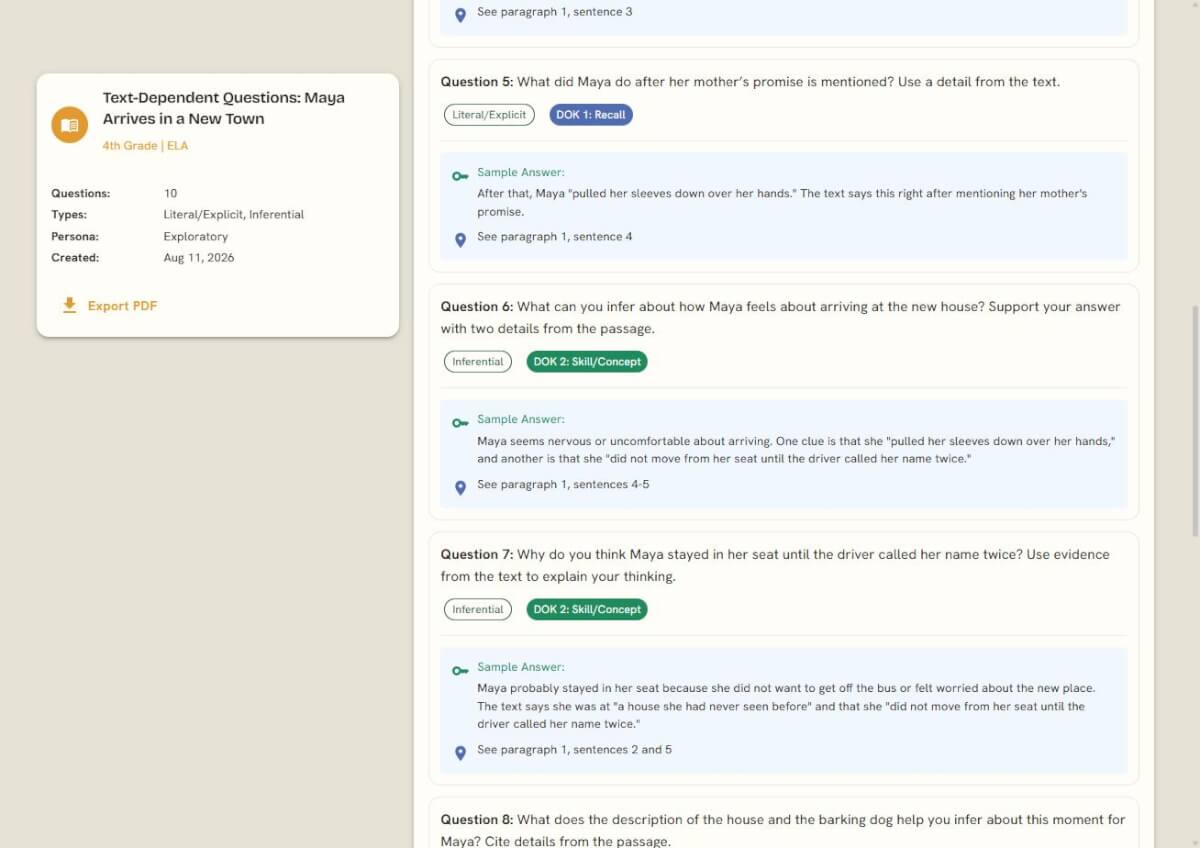
If you want ready-made aligned prompts, PlanSpark’s Text-Dependent Questions tool can help generate stems and questions connected to the text and standard you’re teaching.
Question stems for citing explicit evidence
- What detail in the text shows ___?
- Which sentence or event best supports the idea that ___?
- What evidence from the story helps you answer this question?
- Which example from the text proves ___?
- What happened in the story that shows ___?
Question stems for drawing inferences
- What can you infer about ___? What details support your inference?
- How does the character most likely feel? Which clues helped you infer that?
- What does the author want us to understand, even though it isn’t stated directly?
- What can you figure out from the character’s actions or words?
- Based on the text, what is likely true about ___?
Question stems that combine both skills
- What can you infer about the character, and which details led you to that conclusion?
- How do the events in this paragraph help you understand ___?
- What is the best answer, and what evidence from the text supports it?
- Which details help you infer the theme, mood, or relationship?
- How do you know your answer is supported by the text?
These stems work in whole group, small group, reading conferences, exit tickets, and written response practice. They’re especially useful in grades 4 and 5 because students need repeated exposure to the same thinking pattern in different texts.
A practical scaffold for students who don’t return to the text
Let’s talk about the students who answer quickly but don’t look back. We all have them. They’re often confident, sometimes correct, and not yet strategic. Instead of saying “go back to the text” over and over, we can give them a concrete process.
Step 1: Teach a three-part answer routine
I like a simple structure students can remember:
- Answer it.
- Prove it.
- Explain it.
For example:
Answer: I infer that Marcus is nervous.
Prove it: The text says his hands were shaking and he kept rereading his note.
Explain it: Those details show he is worried about what will happen next.
This keeps students from stopping after the first sentence.
Step 2: Color-code the thinking
Early in the year, visual supports make a big difference. Try this:
- Highlight the answer in one color.
- Highlight the text evidence in a second color.
- Underline the explanation in a third color.
In fourth grade, color-coding helps students see that evidence is a distinct part of the response, not an optional extra.
Step 3: Use sentence frames without apologizing for them
Sentence frames are not a crutch. They’re a bridge. For students who struggle to support their thinking, try frames like these:
- I infer that ___ because the text says ___.
- One detail that supports my answer is ___.
- The author shows ___ when ___.
- This makes me think ___ because ___.
- In paragraph __, the text states ___, which shows ___.
These frames are especially helpful for multilingual learners, students with language-processing needs, and any student who understands the text but needs structure for academic responses.
Step 4: Narrow the hunt
Some students avoid returning to the text because they genuinely don’t know where to look. We can scaffold that by narrowing the search area:
- “Reread the second paragraph.”
- “Look at what the character says on page 3.”
- “Find the part right after the storm begins.”
This is often more effective than a general “find evidence.” Once students build confidence, we can gradually release that support.
Step 5: Start with oral rehearsal
Before asking for written evidence-based responses, let students practice orally with partners:
Partner A: What do you infer?
Partner B: What detail supports that?
This quick routine builds the habit of backing up an idea. It also lets us hear misconceptions before they land on paper.
What this looks like across upper-elementary ELA
RL.4.1 lives most naturally in reading, but it also connects beautifully to writing and speaking standards. When students discuss a chapter book, respond to a read-aloud, or write about character traits, we can keep the same expectation: show us where the text helped you think that.
In whole-group reading
Pause after a meaningful moment and ask one inference question and one evidence question. Keep the pairing consistent. For example:
- Inference: How is Ana feeling right now?
- Evidence: What words or actions in the text make you think that?
In small-group instruction
Use shorter passages and preplanned stopping points. This is a good place to reteach how to choose the best detail, not just any detail. If a student gives weak evidence, ask, “Is there a stronger part of the text that proves your answer even better?”
In written response practice
Keep expectations short and clear early in the year. A complete RL.4.1 response does not have to be a full paragraph every time. Often, two or three well-structured sentences are enough to assess the standard.
Common teacher moves that strengthen RL.4.1
- Model imperfectly, then revise. Show a weak answer and improve it together.
- Praise the evidence habit. Name what students did well: “You didn’t just answer—you used the character’s actions as proof.”
- Teach evidence selection. Not every detail is equally helpful. Help students choose the most relevant example.
- Keep anchor charts practical. A chart with “Answer it, Prove it, Explain it” will get more use than a definition-heavy poster.
- Revisit the skill across texts. Don’t save RL.4.1 for one unit. Use it with realistic fiction, fantasy, historical fiction, and poetry discussions.
Planning RL.4.1 without overcomplicating it
When we plan for RL.4.1, we do not need a brand-new system every week. A steady structure works better:
- Choose a short literary text or excerpt.
- Identify one explicit detail question and one inference question.
- Model a response using evidence.
- Give students a frame or routine.
- Release to partner talk or written practice.
If you want support organizing the standard into student-friendly skills, the Standards Unpacker can help you break it into teachable parts. And if you want a quick public reference to share with teammates, the free Standards Unpacker and this RL.4.1 standard breakdown make planning conversations much easier.
For daily question creation, the Text-Dependent Questions tool is especially useful when you want aligned stems without reinventing them after a long day.
Final thoughts on teaching RL.4.1 early in the year
RL.4.1 is one of those standards that pays off all year long. When students learn early that their ideas need evidence, they become stronger readers, more thoughtful discussants, and clearer writers. We don’t need to rush them there. We just need to be consistent: model the thinking, give them language they can use, and make returning to the text part of the routine.
If your students are still answering from memory or instinct, that’s not failure. That’s our starting point. With clear question stems, short response structures, and plenty of guided practice, they can learn to support inferences with confidence. If you’re planning your next reading lesson, start with one strong RL.4.1 question, one visible model, and one scaffold your students can actually use tomorrow.
And if you want a little support as you plan, take a look at PlanSpark’s tools for unpacking standards and generating aligned questions. Sometimes having the right teacher-side support is exactly what helps us keep instruction simple, focused, and doable.