
Some standards look simple on paper and turn into a tangle the minute we teach them. RL.3.2 is one of those. We read the wording and think, “Yes, my students can retell a story.” Then we ask for the central message, and suddenly we get a play-by-play of every squirrel, sandwich, and side character in the text. If you’ve ever listened to a 3rd grader recount every detail except the part that matters most, you are in very good company.
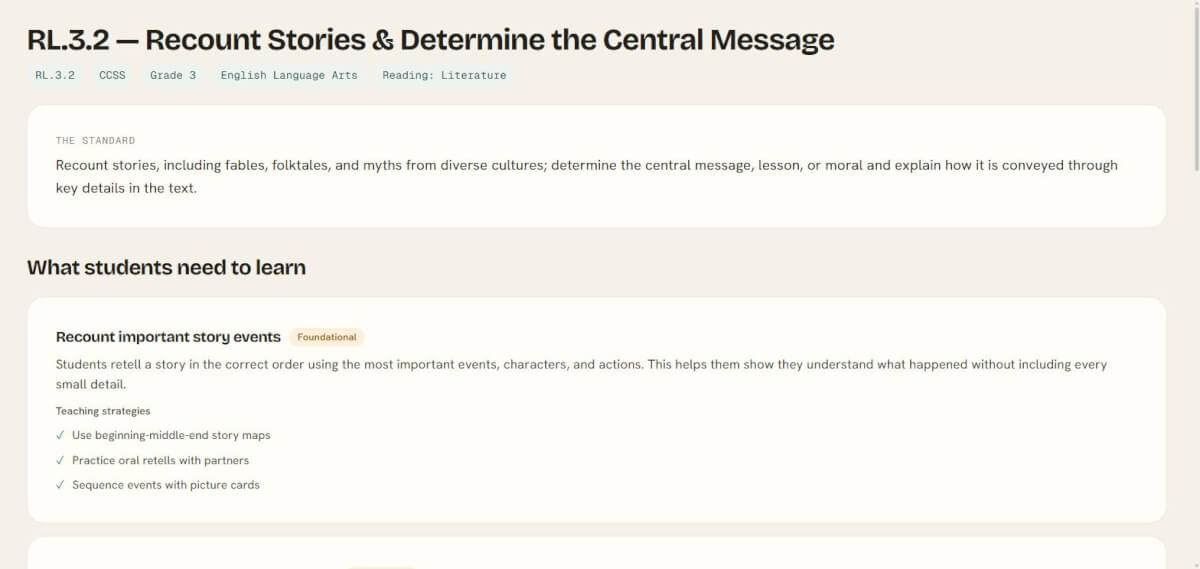
When we unpack RL.3.2 carefully, the teaching gets much clearer. This standard is not asking students to give a full dramatic retelling of every event. It is asking them to recount stories and determine the central message, lesson, or moral, then explain how that message is conveyed through key details in the text. That last part matters. Students are not just naming a lesson like “Be kind.” They are connecting the lesson to what actually happened in the story.
If you want a quick reference while you plan, PlanSpark has both the in-app Standards Unpacker and a free no-signup Standards Unpacker. For this exact standard, you can also jump straight to the RL.3.2 standard breakdown. Those tools are helpful when we want the language of the standard translated into teachable parts without sorting through a dozen tabs.
What RL.3.2 really asks students to do
Let’s put RL.3.2 into plain teacher language. In 3rd grade, students should be able to do three things:
- Recount the story by telling the important events in order.
- Figure out the central message, lesson, or moral the author wants readers to understand.
- Explain how key details show that message instead of giving a lesson that is disconnected from the text.
That means RL.3.2 sits right at the intersection of comprehension, sequencing, and theme work at an elementary level. We are not asking 3rd graders for a sophisticated literary analysis. We are asking them to move beyond “what happened” and into “what the story teaches.”
What does “recount” mean in 3rd grade?
For our students, recount means a concise retelling of the important parts of the story in a logical order. It is not every detail. It is not a summary stuffed with minor events. It is not a personal reaction.
A strong recount usually includes:
- Main characters
- The important events
- The problem and how it is resolved
- Events told in sequence
I often tell students, “Recount means tell the story again in a shorter, smarter way.” That wording helps. They need permission to leave things out.
What counts as a “central message”?
In RL.3.2, the central message is the big idea the story teaches readers. In many fables and folktales, this is close to the moral. In realistic fiction, it may sound more like a lesson about choices, friendship, honesty, perseverance, or kindness.
Some student-friendly examples:
- Slow and steady work can lead to success.
- Being honest is better than trying to impress others.
- Greed can cause people to lose what they already have.
- Working together can solve a problem.
The key is that the central message should be broad enough to matter beyond one story, but specific enough to be supported by the text.
Why students struggle with RL.3.2
When students miss RL.3.2, it usually is not because they cannot think deeply. More often, they are mixing up the parts of the task.
Sticking point 1: They retell everything
Many 3rd graders think a “good retell” means including every single event they remember. They want to prove they listened, so they pile on details. The result is a recount that is long, unfocused, and hard to use as evidence for a central message.
What helps: teach students to sort events into important and interesting but not essential. During a read-aloud, pause and ask, “If we had to tell this story in 3 or 4 steps, does this part make the cut?”
Sticking point 2: They give a topic, not a message
Students often answer with one word: friendship, kindness, sharing. That is a topic, not a central message.
What helps: give a simple frame such as, “The story teaches that ______.” Then require evidence: “I know this because ______.”
Sticking point 3: They choose a lesson that could fit any book
We have all heard it: “The lesson is be nice.” Maybe. But can the student show how the character’s actions and the outcome teach that lesson?
What helps: ask, “Which details from the story prove that?” If the student cannot name key events, the answer is probably too vague.
Sticking point 4: They confuse central message with main idea
Because students hear “main idea” in informational text, they sometimes use the same thinking in literature. RL.3.2 is not asking for what the text is mostly about. It is asking what the story teaches.
What helps: keep a visible comparison chart.
- Topic: what the story is about
- Recount: the important events in order
- Central message: what the story teaches
A read-aloud-friendly teaching sequence for RL.3.2
If I were planning RL.3.2 with a teammate, I would start with fables. Fables are short, clear, and naturally built for central message work. They let us model the difference between recounting events and naming the lesson without overwhelming students with plot complexity.
Step 1: Start with a familiar fable and model a short recount
Try The Tortoise and the Hare. It is ideal because the plot is simple and the moral is easy to trace through events.
After reading aloud, model a recount like this:
“The hare bragged that he was faster than the tortoise, so they raced. During the race, the hare stopped to rest because he was too confident. The tortoise kept going slowly and did not give up. In the end, the tortoise won the race.”
Then think aloud: “I did not tell every detail. I told the important events in order.”
Step 2: Move from recount to central message
Next, ask: “What does this story teach us?” Students may say, “Go slow,” or “The turtle wins.” That is our opening to refine.
Model this move: “A stronger answer is, ‘Slow and steady effort can lead to success.’ I know that because the tortoise kept working, while the hare wasted time by showing off and resting.”
That short explanation is the heart of RL.3.2.
Step 3: Use a simple anchor chart
Create an anchor chart with three boxes:
- Somebody/Characters
- Important events in order
- What the story teaches
Under the final box, add the sentence stem: “The story teaches that ______. I know this because ______.”
Keep this chart visible for every read-aloud in the first week of instruction.
Step 4: Practice with more fables before moving to longer texts
Good choices include:
- The Boy Who Cried Wolf
- The Lion and the Mouse
- The Goose That Laid the Golden Eggs
- The Ant and the Grasshopper
These texts make patterns visible. Students begin to see that the message comes from the character’s choices and the consequences that follow.
Step 5: Gradually release to partners, then independent work
Once students have heard several modeled examples, shift to partner talk:
- Partner A recounts the story in 3 to 4 events.
- Partner B states the central message.
- Together, they choose two key details that support it.
Then move into short written responses.
Concrete question stems that actually help
Sometimes the right question stem does more than a whole mini-lesson. Here are stems that keep students focused on RL.3.2 instead of drifting into random retell.
For recounting
- Who are the main characters in this story?
- What important event happens first?
- What problem does the character face?
- What happens next that really matters?
- How is the problem solved?
- If you could only tell this story in 3 sentences, what would you include?
For central message
- What does the author want us to learn from this story?
- What lesson did the character learn?
- What message could apply in real life, not just in this story?
- Which events help you figure out the lesson?
- What happened in the story that proves your idea?
If you want ready-made support for this kind of close reading, PlanSpark's Text-Dependent Questions tool can help generate text-based prompts we can adapt for read-alouds, small groups, or written responses.
What this sounds like in the classroom
Here is a quick example using The Lion and the Mouse.
Teacher: “Recount the story in just the most important parts.”
Student: “A lion caught a mouse, but he let it go. Later, the lion got trapped in a net. The mouse chewed the ropes and helped free the lion.”
Teacher: “Good. Now what is the central message?”
Student: “Be nice.”
Teacher: “That’s a start. Can we say the lesson in a way that matches the story more closely?”
Student: “Even someone small can help in a big way.”
Teacher: “Yes. Which details show that?”
Student: “The lion thought the mouse was too little to matter, but later the mouse was the one who saved him.”
That exchange is exactly where we want students to land.
Simple scaffolds for students who need more support
Use a “most important events” limit
Tell students they may include only 3 or 4 events in their recount. Limits force prioritizing.
Offer central message choices before open-ended responses
For some learners, especially early in the unit, give two possible lessons and ask which one fits best and why.
Pair oral rehearsal with writing
Before asking students to write, let them say: “First… Next… Then… Finally…” followed by “The story teaches that…” Oral language strengthens written responses.
Color-code evidence
Have students highlight the central message in one color and the supporting details in another. This makes the connection visible.
How to know students are really meeting RL.3.2
Students are on track with RL.3.2 when they can do more than repeat a moral from memory. We should see that they can:
- Retell only the important events, in order
- State a lesson or message in a complete thought
- Use story details to explain how they know
- Apply the skill across fables, folktales, and other literary texts
A quick exit ticket can be enough: “Recount this story in 3 sentences. Then write one sentence telling the central message and one sentence explaining which detail shows it.”
Plan tomorrow’s RL.3.2 lesson with less guesswork
RL.3.2 gets much easier to teach when we stop treating “recount” and “central message” as one blended skill. First, we teach students to tell the important events in order. Then, we show them how those events reveal the lesson. Fables are our best friend here because they make the thinking visible fast.
If you want a planning shortcut, take a look at PlanSpark’s free Standards Unpacker, the in-app Standards Unpacker, and the full RL.3.2 standard breakdown. They can help us turn RL.3.2 into clear lesson targets, useful question stems, and instruction that actually fits what 3rd graders need. Pick one fable, keep the recount short, press for text evidence, and you’ll be surprised how quickly students begin hearing the message under the plot.