
We’ve all seen it: a third grader reads an article, gives a confident answer, and when we ask, “How do you know?” they look back at us with a shrug and say, “Because I already knew that,” or “I just think that’s right.” That moment is exactly why RI.3.1 matters so much in third-grade ELA.
At this level, our students are moving beyond simply understanding a text in a general way. RI.3.1 asks them to ask and answer questions about informational text and to refer explicitly to the text as the basis for their answers. In plain language? Third graders need to answer with what the page says, not just what they know, guess, or remember from somewhere else.
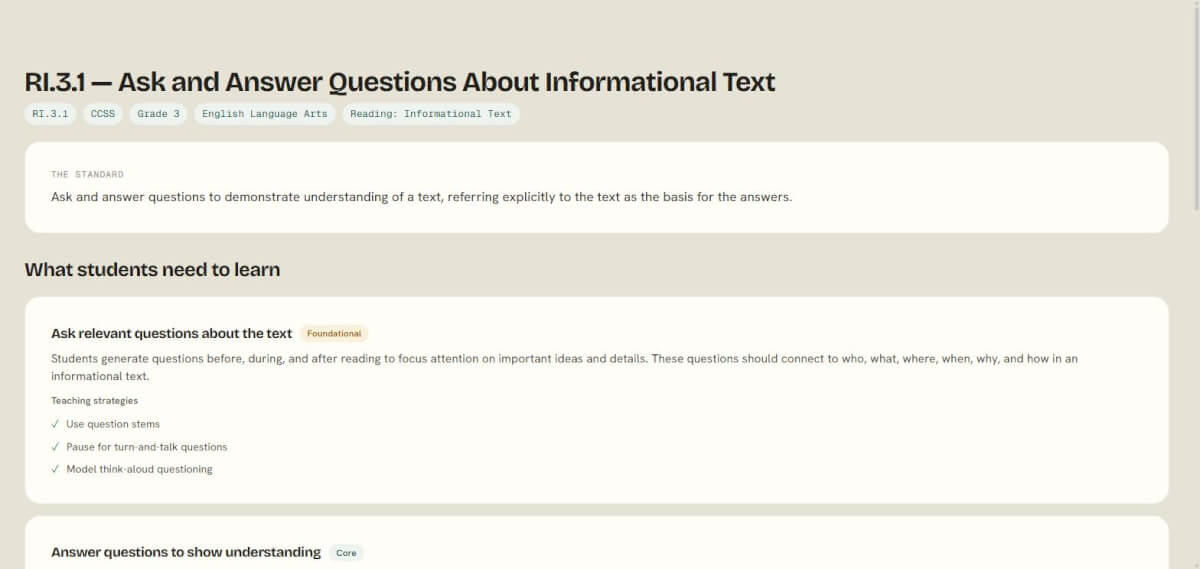
If you want a quick teacher-friendly overview of the standard, PlanSpark offers both an in-app Standards Unpacker and a free Standards Unpacker. You can also jump straight to this specific RI.3.1 standard breakdown for a ready-made look at the skill, what students need to do, and how to plan for it.
Let’s unpack what this standard is really asking, why nonfiction can trip up students who seem perfectly strong in fiction, and how we can teach a simple set of question stems and routines that work across almost any article.
What RI.3.1 Really Means in Student-Friendly Language
The official wording of RI.3.1 is: ask and answer questions to demonstrate understanding of a text, referring explicitly to the text as the basis for the answers.
That can sound a little dense, so here’s the classroom version:
- Ask questions about what the article says.
- Answer questions using information from the article.
- Show where the answer came from by pointing to the exact sentence, detail, heading, caption, or paragraph that supports the answer.
For third graders, “refer explicitly to the text” does not mean they need to write a formal citation. It means they can say things like:
- “In the second paragraph, it says…”
- “The caption tells us…”
- “I found the answer under the heading…”
- “The article says…”
That’s the heart of the standard. We are teaching students to ground their thinking in the text itself.
What students should be able to do by the end of instruction
- Read or listen to an informational text and notice important details
- Ask questions before, during, and after reading
- Answer who, what, where, when, why, and how questions about the text
- Go back into the text to find the evidence for an answer
- Explain their answer using words or details from the passage
Notice that this is not just a comprehension standard. It is also an evidence standard. Students are not done when they answer correctly. They are done when they can show how the text supports that answer.
Why Informational Text Feels Harder Than Fiction for Many Third Graders
Many of our students can read a story and talk about the characters, problem, and events with no trouble at all. Then we hand them a short article about penguins, weather, or communities, and suddenly their comprehension seems shaky. That’s not unusual.
Nonfiction asks students to read differently.
Here’s what often gets in the way
- The structure is less familiar. Stories move in a sequence. Informational text may be organized by topic, subtopic, cause/effect, or description.
- Text features matter. Headings, captions, labels, diagrams, and bold words carry meaning. Some students skip them.
- Background knowledge gets in the driver’s seat. If students know something about the topic already, they may answer from memory instead of from the page.
- The answer may not be in one tidy sentence. Students often need to connect details from two nearby sentences, a heading plus a paragraph, or a diagram plus the body text.
That last point is important. A child may truly understand the topic, but RI.3.1 is asking for something more specific: “Can you show me where the text gave you that idea?”
The Big Wrong Turn in RI.3.1: Answering From Background Knowledge Instead of the Page
If I had to name the most common stumbling block with RI.3.1, this would be it. A student reads an article about frogs, and when asked, “Why do frogs need moist skin?” they answer based on a documentary they watched, a classroom discussion, or a fact they learned last year.
The problem is not that background knowledge is bad. We want students to connect what they know to what they read. The problem is that for this standard, the source of the answer matters.
What it sounds like in the classroom
- “I know that already.”
- “My dad told me that.”
- “I saw that on TV.”
- “I think it means…”
Those responses tell us the student may be thinking, but not yet anchoring that thinking in the text.
How to redirect without shutting students down
We never want to punish curiosity or prior knowledge. Instead, we can redirect gently and consistently:
- “That might be true. Now let’s see if the article says that.”
- “What in the text helped you answer?”
- “Point to the sentence that made you think that.”
- “Can you show me the paragraph, heading, or caption where you found it?”
- “Let’s prove it from the page.”
I like to teach a simple distinction:
- What I know = background knowledge
- What the text says = evidence
Both matter, but during RI.3.1 practice, we train students to finish with the second one.
A Simple Teaching Routine for RI.3.1
When a standard is tricky, a predictable routine helps. Here’s one that works well with short articles, science or social studies passages, and weekly reading practice.
Step 1: Preview the text features
Before reading, take one minute to notice the title, headings, photographs, captions, charts, or diagrams. Ask:
- “What do you think this section will teach us?”
- “Which text feature might help us find an answer later?”
This matters because students often forget that evidence can come from more than the body paragraph.
Step 2: Read in short chunks
Stop after a paragraph or section, especially early in the year. After each chunk, ask one quick question and have students locate the answer immediately.
For example, after a paragraph about how bees pollinate flowers, ask: “What job do bees do for plants?” Then follow up with: “Where do you see that in the text?”
Step 3: Use the answer-and-prove frame
Give students a sentence frame they can use orally and in writing:
The answer is ________. I know because the text says ________.
Later, you can make it more precise:
In the ________ paragraph/section/caption, the text says ________, so the answer is ________.
Step 4: Highlight or point to evidence
Have students underline, sticky-note, or physically point to the evidence before sharing their answer. This small move slows down guessing and builds the habit of going back to the text.
Step 5: Release responsibility gradually
- I do: Model finding and naming the evidence.
- We do: Find evidence together.
- You do: Students answer and cite the text independently.
Third graders need a lot of repetition here. That’s normal.
Reusable Question Stems for Any Informational Text
One of the easiest ways to build consistency with RI.3.1 is to use the same family of question stems all year long. When students recognize the structure of the questions, they can focus more energy on the reading itself.
If you want ready-made support, PlanSpark's Text-Dependent Questions tool can help generate aligned stems and text-based questions for informational reading.
General understanding stems
- What is this section mostly about?
- What does the author explain about _____?
- What is one important detail you learned from this paragraph?
- Which detail helps us understand the topic?
Ask-and-answer stems
- What question could we ask after reading this section?
- What is the answer to that question?
- Which part of the text helps answer it?
- What detail would you use as proof?
Evidence-focused stems
- Where in the text did you find your answer?
- Which sentence or paragraph supports your answer?
- What words from the text helped you know that?
- Can you point to the heading, caption, or diagram that gave you that information?
Deeper thinking stems that still stay text-based
- Why does the author include this detail?
- How does this diagram help you understand the paragraph?
- What can you conclude from these two details?
- Which detail best supports the idea that _____?
These stems work across science articles, social studies texts, and high-interest nonfiction passages. They also help us keep instruction aligned instead of drifting into disconnected comprehension practice.
What RI.3.1 Looks Like Across the Lesson
During whole-group instruction
Project a short passage and think aloud:
“The question asks why earthquakes happen. I think the answer is in this paragraph because it explains movement under Earth’s surface. Let me underline the sentence that says, ‘Earthquakes happen when plates suddenly shift.’ That’s my proof.”
Be explicit about the process, not just the answer.
During small group
Use shorter text chunks and give students a pencil-only task:
- Read one paragraph.
- Answer one question.
- Underline the proof.
- Tell a partner: “My answer is ____. My evidence is ____.”
This is especially helpful for students who can answer orally but struggle to locate evidence independently.
During independent practice
Keep the written task short at first. Instead of a full page of questions, try:
- 1 question
- 1 answer
- 1 underlined sentence as evidence
That gives us cleaner data on whether the student can actually do the skill.
Concrete Examples of Strong and Weak Responses
Question: Why do some animals migrate?
Weak response: “Because it gets cold.”
This may be true, but it does not refer to the text.
Stronger RI.3.1 response: “Some animals migrate to find food and warmer places. In the second paragraph, the text says they move when the weather changes and food is harder to find.”
Question: How do clouds form?
Weak response: “From water.”
Too vague, and no evidence.
Stronger RI.3.1 response: “Clouds form when water vapor cools and turns into tiny drops of water. The article says that in the paragraph under the heading ‘How Clouds Begin.’”
These comparisons help students see that a correct answer is only part of the job.
Helpful Supports for Students Who Need More Scaffolding
- Color-code the work: Write the answer in one color and underline the evidence in another.
- Provide sentence frames: “The text says… so the answer is…”
- Limit the search area: Tell students, “The answer is in paragraph 2 or the caption.”
- Use partner talk first: Oral rehearsal often improves written responses.
- Teach text feature language directly: heading, caption, diagram, label, paragraph, section.
These supports are especially useful for multilingual learners, students with reading difficulties, and any child who understands more than they can yet explain in writing.
Planning RI.3.1 With Less Stress
If you’re mapping instruction and want the standard broken into teachable pieces, the in-app Standards Unpacker is useful for planning lessons and checks for understanding. If you just want a quick no-signup look, the free Standards Unpacker is a great place to start, and the specific RI.3.1 standard breakdown makes it easier to see exactly what to model, practice, and assess.
The goal is not to turn every nonfiction lesson into a complicated evidence essay. The goal is simpler and more important: helping third graders build the habit of answering from the page.
Final Thoughts on Teaching RI.3.1
RI.3.1 is one of those foundational standards that pays off all year long. When students learn to ask questions, answer carefully, and show where the answer came from, they become stronger readers in every subject area. Science, social studies, and even math problem solving benefit from this habit.
If your students keep slipping into background knowledge, don’t worry. That is a normal part of the learning curve. We just keep redirecting: “Show me where the text says that.” With consistent question stems, short chunks of nonfiction, and lots of practice pointing back to the page, our third graders get there.
If you’re planning your next informational reading lesson, start with one short article, one text-based question, and one simple expectation: answer it and prove it. Then explore PlanSpark’s tools to make the work lighter, including the Text-Dependent Questions tool, the Standards Unpacker, and the free RI.3.1 breakdown. We don’t need fancy routines to teach this well. We just need clear modeling, steady practice, and the reminder our students need most: the page has the proof.