
We have all had that moment: first period walks in, and within five minutes we can already see the spread. A few students are ready to sprint, a few need a steady jog, and a few are still tying their shoes. That is the everyday reality of teaching mixed-readiness classes. The good news is that differentiated lesson planning does not have to mean writing three separate lessons, creating a mountain of materials, or spending your Sunday night reinventing everything.
The most workable approach is much simpler: plan one strong lesson around the students who are actually in front of us, then build in a few purposeful access points. When we start with what our class needs, rather than trying to create completely different experiences for every student, differentiation becomes manageable. It is not about doing more plans. It is about making smarter choices inside one plan.
In this post, I want to walk through a realistic process we can use right away. It starts with knowing our learners, continues with a shared lesson goal, and adds a few practical moves like tiered tasks, reading-level adjustments, and flexible supports. If you teach third grade math, seventh grade science, or high school English, the structure holds up.
Start differentiated lesson planning with who is in the room
The most helpful differentiation happens before we pick the activity. It begins with a clear picture of our class. Not a vague sense that “some are high and some are low,” but a working understanding of readiness, stamina, language needs, confidence, and independence.
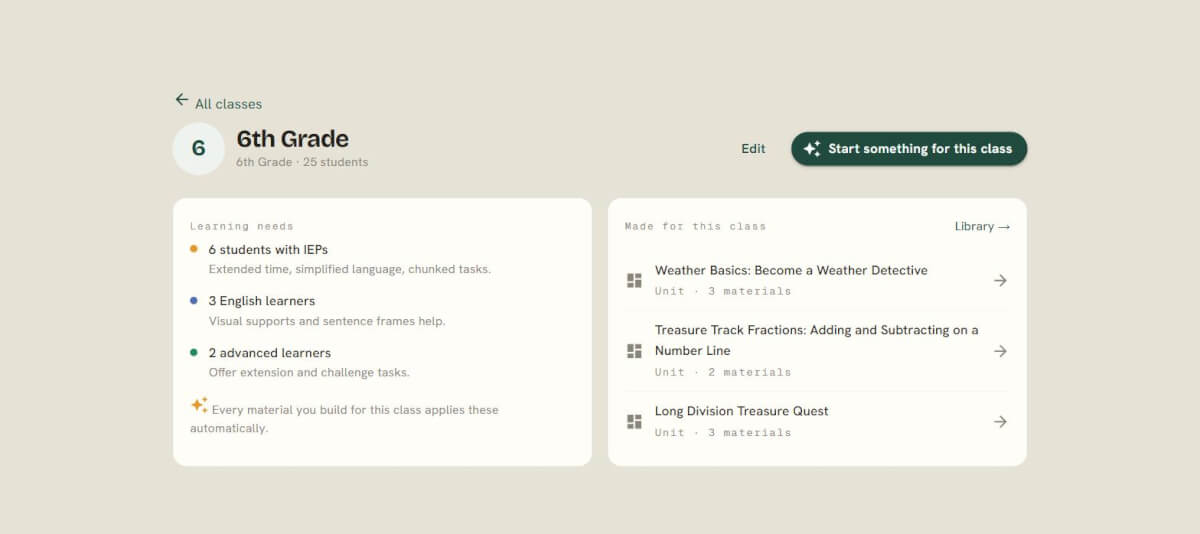
That is why I always encourage teachers to build from a class profile. A good class profile helps us sort what matters instructionally: Who needs chunked directions? Who can handle grade-level text with light support? Who needs vocabulary pre-teaching? Who is ready for deeper application? If you want a simple place to organize that thinking, PlanSpark's Class Profiles tool can help us gather those patterns in one spot so we plan with actual students in mind, not just a generic class.
When we know our students well, we stop over-planning and start targeting. We can look at one lesson and ask:
- Which students will need an easier entry point?
- Which students can work with the core task as written?
- Which students need an extension that increases complexity, not just more work?
- Which students need the text, directions, or questions adjusted for access?
That is the foundation of differentiated lesson planning that respects our time. We are not building three separate roads. We are building one road with a few sensible ramps.
Plan one lesson, not three
Here is the mindset shift that saves time: keep the objective, mini-lesson, and essential question the same for everyone whenever possible. Differentiate the path students take to get there.
That means most of the lesson stays shared:
- One standard or learning target
- One opening or hook
- One focused mini-lesson
- One common success criteria
- One closing reflection or exit ticket
Then we adjust one or two parts, usually the practice task, text complexity, scaffolds, or product options.
For example, if the objective is “Students will identify how an author develops a theme,” we do not need three different objectives. We need one clear objective and a plan for how different students will access the reading and demonstrate understanding.
A simple planning sequence that works
- Choose the standard and objective. Keep it tight and student-friendly.
- Identify the likely barriers. Reading load? Background knowledge? Multi-step writing? Vocabulary?
- Group students by support needs for this lesson. Not forever groups, just for today.
- Create one core task. This is the work most students can do with reasonable support.
- Add a lighter-entry version and a deeper-thinking version. Same goal, different level of scaffolding or complexity.
- Decide what can be adjusted quickly. Text level, sentence stems, number of problems, or choice in response format.
If you want help generating the lesson structure itself, PlanSpark's Lesson Plan Generator is useful for sketching the shared lesson first, then adding the supports and extensions where they actually matter.
Use tiered tasks without turning them into separate lessons
Tiered tasks are one of the easiest ways to differentiate without doubling prep. The key is to tier by support or complexity, not by creating unrelated activities.
Think of it this way:
- Tier 1: heavier support, fewer steps, clearer scaffolds
- Tier 2: core grade-level task
- Tier 3: greater complexity, more independence, deeper application
All three tiers should aim at the same learning target.
Example: Grade 5 math
Standard focus: Multiply multi-digit whole numbers.
Whole-class mini-lesson: Model one problem using place value strategy and area model.
Tiered practice:
- Tier 1: Students solve 4 problems with partial setup provided and a place-value chart.
- Tier 2: Students solve 6 grade-level problems independently, choosing a strategy.
- Tier 3: Students solve 4 problems and explain which strategy is most efficient in each case, including one error analysis item.
Same skill. Same mini-lesson. Same exit ticket. Different levels of support and reasoning.
Example: Grade 8 science
Objective: Explain how changes in temperature affect particle motion.
- Tier 1: Use a labeled diagram bank and sentence frames to explain two examples.
- Tier 2: Write a short explanation using academic vocabulary from the lesson.
- Tier 3: Apply the concept to a new scenario and defend the explanation with evidence.
Again, we are not writing three science lessons. We are adjusting the demand of the task.
Adjust reading levels instead of replacing the whole lesson
For many of us, the biggest barrier in a mixed-ability class is text. Students may be working toward the same social studies, science, or ELA standard, but the reading load can block access before they even get to the real thinking.
This is where reading-level adjustment can save a lesson.
Rather than scrapping the whole activity, keep the same topic, standard, and key ideas, but offer the text in different levels of complexity. That might mean:
- a shortened version with simpler syntax
- a version with key vocabulary supported
- the original grade-level text for students ready to tackle it
- an enriched text set for students ready to compare sources
If you need to make those text changes quickly, PlanSpark's Text Rewrites tool can help adjust reading level while keeping the core content intact. That matters because we do not want some students doing “baby work” while others do the real lesson. We want all students thinking about the same important content with materials they can actually access.
Example: High school English
Say the class is analyzing a complex speech. We might use:
- the original text for students who can manage it with annotation support
- a lightly simplified version for students who need cleaner syntax
- a chunked version with bolded key claims and margin notes for students who need stronger scaffolds
Then everyone answers the same essential question: How does the speaker build the central argument?
That is differentiation with dignity. Students work toward the same target, but with texts that match their current readiness.
Choose 3 built-in differentiation moves and use them consistently
We do not need twenty strategies in every lesson. In fact, too many moving parts usually create more work than learning. I recommend picking three reliable moves we can use again and again.
1. Vary the support, not the expectation
Keep the learning target consistent, but change the scaffolds. That can include sentence starters, graphic organizers, models, manipulatives, checklists, vocabulary banks, or guided notes.
Example: In fourth grade social studies, all students explain cause and effect in a historical event. Some use a cause/effect organizer and sentence stems. Others write a paragraph independently.
2. Vary the text or input
This is especially important in content-area literacy. If the standard is about analyzing ideas, we should not let decoding difficulty become the only gatekeeper.
Example: In sixth grade science, students read about ecosystems. Some get the full article, some get a revised version, and some also listen to the text read aloud before discussion.
3. Vary the output when it makes sense
Sometimes students can show mastery in different ways without changing the rigor. One student writes a paragraph, another completes a labeled model and oral explanation, another records a short response using academic vocabulary.
The caution here is important: choice should still align to the standard. We are not offering random options. We are offering different ways to show the same learning.
Use flexible groups based on the lesson, not labels
One trap in mixed-ability teaching is grouping students the same way every day. Over time, those groups start to feel permanent, and students notice. A more effective approach is flexible grouping based on the needs of the lesson.
For one lesson, we may group by reading support. For another, by math strategy. For another, by pace or by discussion readiness.
Here are a few group structures that keep planning manageable:
- Teacher table: brief reteach or guided start for students who need support
- Partner work: students process the same task with a peer
- Independent core group: students complete the main task with light monitoring
- Extension group: students move into transfer, application, or justification
The important part is that students move in and out of these groups. Today's support group may include different students than tomorrow's. That keeps the focus on learning needs, not fixed ability labels.
A planning template for a mixed-ability lesson
If you want a quick way to think through tomorrow's lesson, try this four-part template:
- Shared target: What is every student learning?
- Core task: What is the main work most students will do?
- Access supports: Who needs adjusted text, modeling, vocabulary, chunking, or guided practice?
- Extension: Who is ready for more complexity, abstraction, or application?
You can jot this on a sticky note, planning template, or digital planner. The point is to keep the planning light but intentional.
What this might look like in practice
Grade 3 ELA lesson: Determine the main idea of an informational text.
- Shared target: I can determine the main idea and support it with details.
- Core task: Read a short article and identify the main idea with three supporting details.
- Access supports: Leveled text version, highlighted key details, picture support, teacher-led small group.
- Extension: Compare the main idea across two short texts on the same topic.
That is one lesson. Not three.
Keep differentiation sustainable
Let me say the quiet part out loud: if a differentiation system depends on us making entirely different materials every day, it will not last. We need routines we can maintain in October, January, and May.
So give yourself permission to keep it simple:
- Differentiate one part of the lesson, not every part.
- Reuse support tools like sentence frames and graphic organizers.
- Adjust text level before creating brand-new assignments.
- Use quick class profile notes to guide decisions.
- Plan extensions that deepen thinking, not just add pages.
Sustainable differentiated lesson planning is less about fancy structures and more about smart repetition. A few well-used moves will carry us much farther than a new strategy every week.
One lesson can still meet many needs
Mixed-ability classrooms are real classrooms. They ask a lot from us, and none of us has unlimited planning time. But we can build lessons that are responsive without building three separate versions from scratch. When we begin with a clear picture of our learners, keep one shared goal, tier the task, and adjust reading levels where needed, differentiation becomes doable.
That is the heart of differentiated lesson planning: not more paperwork, but better fit. Start with who's in the room, choose one lesson worth teaching, and add the supports that help more students reach it.
If you want to make that process easier this week, try using Class Profiles to organize what your students need, sketch your shared lesson with Lesson Plans, and adjust complex passages with Text Rewrites. Small planning moves can make a big difference in how smoothly a mixed-ability lesson runs. We do not have to do everything at once. We just need a practical place to start.