
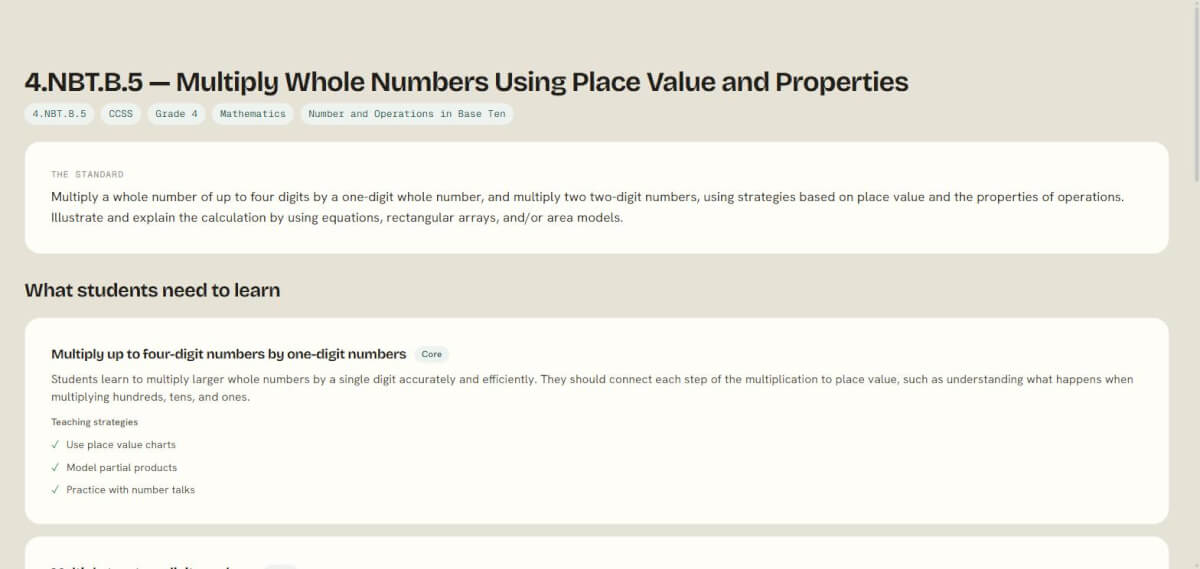
If you've ever had a fourth grader solve 23 × 15 with the standard algorithm, get 345, and then stare blankly when asked why it works, you're in familiar company. Many of us were taught to multiply by following steps, carrying digits, and hoping accuracy would come with repetition. But 4.NBT.B.5 asks for more than a correct answer. It asks students to multiply whole numbers using place value understanding and the properties of operations, and to illustrate and explain the calculation with equations, rectangular arrays, and area models.
That matters because the algorithm is not the goal by itself. The goal is understanding. When we teach 4.NBT.B.5 as a progression—from concrete visual models to increasingly efficient written methods—we give students something sturdier than a procedure to memorize. We give them a reason the procedure makes sense.
If you want a quick standards overview before planning, PlanSpark offers a free 4.NBT.B.5 standard breakdown, and if you're working inside the platform, PlanSpark's Standards Unpacker can help you translate the language of the standard into teachable lesson moves.
What 4.NBT.B.5 actually requires
Let's start with the exact heart of 4.NBT.B.5. Students are expected to:
- Multiply a whole number of up to four digits by a one-digit whole number
- Multiply two two-digit numbers
- Use strategies based on place value and the properties of operations
- Illustrate and explain the calculation using equations, rectangular arrays, and/or area models
There are a few important implications packed into that wording.
The standard is about strategy and explanation, not just answer-getting
If a student can compute 34 × 27 using the standard algorithm but cannot connect the work to tens and ones, decomposition, or partial products, that student is not yet fully meeting the spirit of the standard. We absolutely want efficiency, but efficiency should rest on understanding.
Visual models are not extras
Rectangular arrays and area models are named directly in the standard. That means they are not optional enrichment activities to do only if we have time. They are part of the mathematical work of fourth grade multiplication.
The standard algorithm is a destination, not the starting point
Notice what the standard does not say: it does not require students to begin with the standard algorithm or to use it in isolation. In fact, a strong interpretation of 4.NBT.B.5 is that students should build toward the algorithm through place-value reasoning and properties of operations.
Why the algorithm alone isn't enough
Most of us have seen what happens when students learn the algorithm as a string of steps:
- They forget when to shift left or where the zero comes from
- They mix up place values in partial products
- They can produce an answer but cannot judge whether it is reasonable
- They struggle to recover when they make one small error
That's because rules without meaning are fragile. But when students understand that 23 × 15 is really (20 + 3) × (10 + 5), they can make sense of every line of work:
- 20 × 10 = 200
- 20 × 5 = 100
- 3 × 10 = 30
- 3 × 5 = 15
- 200 + 100 + 30 + 15 = 345
Now the answer is not magic. It's built from place value. That understanding supports estimation, error analysis, and transfer to larger numbers later on.
In other words, the algorithm is efficient because it compresses ideas students should already understand. If we teach the compressed version first, many children never see the ideas underneath.
A strategies-first teaching sequence for 4.NBT.B.5
Here is the sequence I'd share with a teammate: start with area and array thinking, move to partial products, and then connect that work directly to the standard algorithm. This sequence keeps the mathematics visible all the way through.
Step 1: Build meaning with arrays and area models
Before students multiply two two-digit numbers on paper, they need repeated experience seeing multiplication as composed area.
Take 23 × 15. Draw a rectangle with side lengths 23 and 15. Then decompose each side:
- 23 becomes 20 + 3
- 15 becomes 10 + 5
The rectangle now has four smaller parts. Students label and solve each section:
- 20 × 10 = 200
- 20 × 5 = 100
- 3 × 10 = 30
- 3 × 5 = 15
This is where we want lots of conversation:
- Why are there four boxes?
- What does each box represent?
- How do we know 20 × 5 is 100?
- Why do we add the parts together?
At this stage, I like to keep numbers manageable and vary the structure:
- 14 × 12
- 32 × 21
- 46 × 13
Students can shade, label, and write matching equations. The visual support helps them connect multiplication to distributive reasoning instead of memorized steps.
If you want practice pages for this exact stage, you can create them with PlanSpark's Worksheet Generator and tailor problems to area models, arrays, or equation matching.
Step 2: Move from area model to partial products
Once students can reliably decompose factors and find the smaller products, partial products become the natural next step.
Using 23 × 15 again, students write:
20 × 10 = 200
20 × 5 = 100
3 × 10 = 30
3 × 5 = 15
200 + 100 + 30 + 15 = 345
Then we can help them organize more efficiently:
23 × 15 = (20 × 15) + (3 × 15)
20 × 15 = 300
3 × 15 = 45
300 + 45 = 345
Both versions are mathematically sound. The key idea is that students still understand why the pieces are being added.
This is also the right time to be explicit about the distributive property in kid-friendly language: we can break apart a factor, multiply each part, and then combine the results.
Step 3: Connect partial products to the standard algorithm
Now we bridge, rather than switch. Too often, we teach partial products for a few days and then suddenly present the standard algorithm as if it were unrelated. Instead, we want students to see that the algorithm is simply a compact recording of the same place-value reasoning.
For 23 × 15:
- 5 × 23 = 115, which represents 5 ones times 23
- 10 × 23 = 230, which represents 1 ten times 23
- 115 + 230 = 345
When students write the second row of the algorithm one place to the left, we should say out loud what that shift means: we are multiplying by 10, not by 1. The placeholder zero is not a decoration. It shows the value of the tens place.
That single sentence clears up a surprising number of errors.
Where students commonly stall
Even with good instruction, there are predictable sticking points in 4.NBT.B.5. Knowing them ahead of time helps us plan better questions and interventions.
1. Place-value slips
Students may compute 20 × 5 as 10, or 3 × 10 as 3, because they are attending to digits rather than value. These students need more verbal rehearsal:
- 2 tens × 5 ones = 10 tens = 100
- 3 ones × 1 ten = 3 tens = 30
Have them say the units as they multiply. It slows the work down in a productive way.
2. Trouble with the zero in the middle
Problems like 406 × 3 or 204 × 6 can expose weak place-value understanding. Students may skip the zero entirely or mishandle regrouping around it.
Helpful moves include:
- Writing expanded form first: 406 = 400 + 0 + 6
- Using place-value disks or base-ten drawings
- Asking, “What does the 0 represent here?”
- Connecting each digit to hundreds, tens, and ones before multiplying
The issue is usually not the multiplication fact. It's that the zero is being read as “nothing to think about” instead of “zero tens.”
3. Misalignment in the algorithm
Some students understand the products but line them up incorrectly when adding. Graph paper, place-value columns, and color-coding tens and ones can help. I also like having students write the partial products version next to the algorithm and draw arrows between corresponding parts.
4. Treating models as separate from computation
A child may complete an area model correctly but then use an unrelated algorithm procedure on the next problem. That tells us the connection hasn't stuck yet. The fix is not more of one or the other in isolation. The fix is bridging tasks:
- Match an area model to a partial-products equation
- Match partial products to an algorithm
- Explain how one line of the algorithm appears in the model
What this looks like in real lesson planning
For most fourth-grade classrooms, this progression works well across several lessons or even a couple of weeks:
- Equal groups and arrays review: Revisit multiplication as area with smaller numbers.
- Area models with one-digit by multi-digit numbers: Example: 3 × 124 using 100 + 20 + 4.
- Area models with two two-digit numbers: Example: 23 × 15, 34 × 12.
- Partial products from models: Write equations directly from the boxes.
- Bridge to the standard algorithm: Show how the same partial products are recorded more efficiently.
- Error analysis and comparison tasks: Which strategy was used? Where did the place-value error occur?
- Mixed practice: Let students choose a strategy and justify it.
That last step matters. By the end of the sequence, some students will still lean on area models, some will prefer partial products, and some will be ready for the standard algorithm most of the time. In fourth grade, that range is perfectly appropriate as long as students can explain their reasoning.
Assessment ideas that align to the standard
If we only assess final answers, we miss much of what 4.NBT.B.5 is asking students to do. Strong assessment tasks include:
- Solve and illustrate 27 × 14 with an area model
- Find the error in a classmate's partial products
- Use an equation to explain why the second row in the algorithm is shifted
- Choose between two strategies and explain which is more efficient for a given problem
In other words, students should compute, represent, and explain.
If you're differentiating practice, it helps to generate separate pages for each phase of the progression—models, partial products, algorithm, and error analysis. You can do that with PlanSpark's Worksheet Generator so students get practice that matches where they are, not just one-size-fits-all multiplication pages.
Planning 4.NBT.B.5 with a little more clarity
One reason this standard can feel tricky is that the wording expects both conceptual understanding and procedural fluency in development. That's a lot to hold at once when we're pacing units, pulling small groups, and trying to respond to what students actually show us.
That's why it helps to unpack the standard before we teach it. The free 4.NBT.B.5 standard breakdown is a good starting point for seeing the skills, representations, and vocabulary embedded in the standard. And if you want to map those ideas into lessons and tasks, PlanSpark's Standards Unpacker can help us turn standards language into daily teaching decisions.
At the end of the day, 4.NBT.B.5 is not really about getting students to mimic a multiplication procedure. It's about helping them understand that our written methods are built on place value and properties of operations. When we teach from area model to partial products to algorithm, we honor what the standard actually requires—and we set our students up to be more accurate, more flexible, and more confident in the long run.
If you're planning this unit now, start with one lesson that makes the math visible. Draw the rectangle. Name the tens and ones. Ask students what each part means. Then build from there. We've all seen how much smoother multiplication goes when the steps finally make sense.