
If you teach 3rd grade math, you know this moment well: we put 4 groups of 3 counters on the table, ask, “How many in all?” and half the class says 7. The other half starts skip-counting, but not always from a clear understanding of what the groups mean. That is exactly why 3.OA.A.1 matters so much. This standard is not just about getting an answer. It is about helping students understand multiplication as a situation: equal groups, a number of groups, and a number in each group.
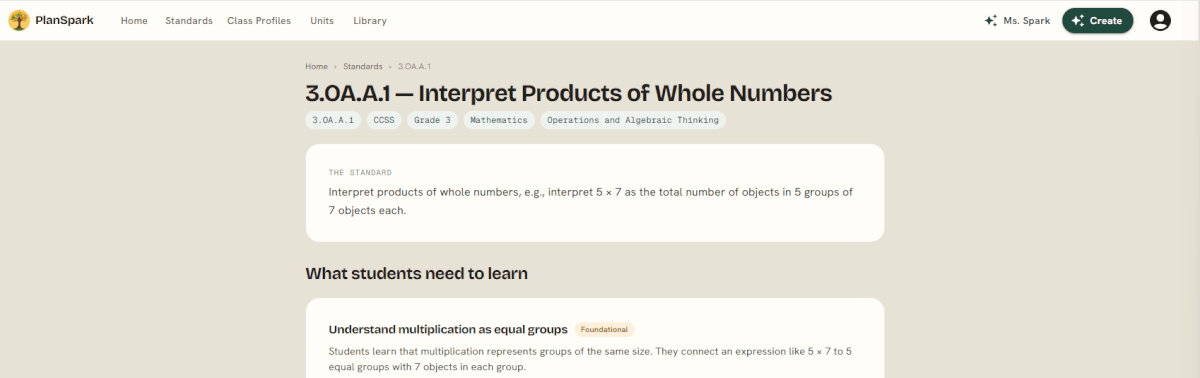
When I explain 3.OA.A.1 to a new teammate, I keep it plain: students need to interpret products of whole numbers in situations with equal groups. In everyday classroom language, that means children should be able to look at or hear a situation like “5 bags with 2 apples in each bag” and understand that multiplication tells us the total, 5 × 2 = 10. Before we rush into facts, timed practice, or arrays on paper, we want that equal-groups meaning to feel solid.
In this post, we will unpack what the standard is really asking, look at the places students commonly get stuck, and map out a first-week teaching sequence you can use right away. If you want a quick way to unpack standards across subjects and grade levels, PlanSpark offers a free, no-signup tool here: PlanSpark's Standards Unpacker. You can also build follow-up lessons from the standard here: PlanSpark's Lesson Plan Generator.
What 3.OA.A.1 really asks students to do
The official language of 3.OA.A.1 asks students to “interpret products of whole numbers.” That phrase can sound a little abstract until we translate it into classroom practice.
In plain language, students should be able to:
- Recognize a situation with equal groups
- Identify the number of groups
- Identify the number in each group
- Represent the situation with a multiplication equation
- Explain what the factors and product mean in context
For example:
- “3 baskets with 4 apples in each basket” means 3 groups of 4.
- The equation is 3 × 4 = 12.
- The 3 tells us the number of groups.
- The 4 tells us the number in each group.
- The 12 is the total number of apples.
That is the heart of the work. We are not yet asking students to master every multiplication fact by memory. We are building meaning first.
It also helps to note what 3.OA.A.1 is closely connected to. Students will soon move into arrays, comparison problems, properties of multiplication, and fact fluency. But equal groups is often the first doorway. If that doorway is shaky, everything after it gets harder.
Equal groups: the model students need to see, build, draw, and explain
When we teach this standard well, we keep coming back to one big idea: equal groups means every group has the same amount. That sounds simple to us, but it is a major conceptual shift for many 8- and 9-year-olds.
What counts as an equal-groups situation?
Good early examples include:
- 4 plates with 3 crackers on each plate
- 6 jars with 2 pencils in each jar
- 5 rows of 4 chairs
- 3 teams with 7 players on each team
In each case, the groups are equal. That sameness is the reason multiplication is useful.
What does not fit the model?
Students also need to see non-examples:
- One plate has 2 crackers, another has 4, another has 3
- A bag of mixed buttons with no equal group structure
- “3 red apples and 2 green apples” with no grouping situation
Showing non-examples helps students understand that multiplication is not just “any story with numbers.” It is a specific kind of situation.
Use multiple representations from day one
For 3rd graders, one representation is rarely enough. We want them moving among:
- Concrete models: counters, cubes, cups, paper plates
- Drawings: circles with dots, quick sketches, repeated pictures
- Repeated addition: 4 + 4 + 4
- Multiplication equations: 3 × 4 = 12
- Words: “3 groups of 4”
If a child can build 3 groups of 4 with counters but cannot match it to 3 × 4, we know exactly where to teach next. That is why representation work is so valuable.
If you want support unpacking the exact language of this standard before you plan, I would encourage you to use PlanSpark's Standards Unpacker and the matching standards page for 3.OA.A.1. It is a helpful way to see what the standard asks in teacher-friendly language before we design tasks.
Common misconceptions with 3.OA.A.1
Here is where many of our students stumble in the first week. The good news is that once we know the likely trouble spots, we can plan for them.
1. Students add the two factors
This is probably the most common error. A student sees 4 groups of 3 and answers 7. Why? Because they are still reading the situation as two separate numbers to combine, not as a number of equal groups.
What helps:
- Physically build the groups
- Ask, “How many groups?” and “How many in each group?” before asking for the total
- Have students point to each group as they count
2. Students confuse the number of groups with the number in each group
A child may build 3 groups of 4 when the story says 4 groups of 3, or vice versa. This confusion is very normal early on.
What helps:
- Use consistent sentence frames: “___ groups of ___”
- Color-code the two quantities on anchor charts
- Have students label drawings: groups / in each group / total
At this stage, I do not panic if students reverse 3 × 4 and 4 × 3, since both give the same total. But I do want them to connect the equation to the story accurately. We are building meaning, not just answer-getting.
3. Students do not understand that equal means same amount
Some children will make 4 groups, but with 2, 3, 4, and 5 counters. They heard “groups,” but missed “equal groups.”
What helps:
- Intentionally compare equal and unequal group models
- Ask, “Can we use multiplication here? Why or why not?”
- Use language like “same number in each group” every day
4. Students can skip-count but do not understand the situation
We all have students who can count by 2s, 5s, or 10s and appear strong at first. But when the numbers change or the story is less familiar, the understanding falls apart.
What helps:
- Ask students to draw or build before solving
- Require explanations: “What does the 5 mean?”
- Use story problems with less-friendly numbers like 3, 4, 6, and 7
5. Students treat every repeated addition problem as multiplication without context
Repeated addition is a helpful bridge, but not every addition expression automatically reflects a clear equal-groups situation in a child’s mind.
What helps:
- Always tie repeated addition back to a model or story
- Ask, “What is being repeated?”
- Connect each addend to one group
A first-week teaching sequence for 3.OA.A.1
If I were opening this standard with a 3rd-grade team, I would keep the first week concrete, language-rich, and repetitive in the best possible way. Here is a simple sequence.
Day 1: Introduce equal groups with real objects
Goal: Students understand that equal groups have the same number in each group.
Give pairs of students counters and small cups or paper circles. Say things like:
- “Make 3 equal groups of 2.”
- “Make 4 equal groups of 5.”
- “Show me a model that is not equal groups.”
Keep the talk focused:
- How many groups?
- How many in each group?
- Are the groups equal? How do you know?
Teacher tip: Resist the urge to jump to equations too fast. Let students handle and discuss the structure first.
Day 2: Connect equal groups to drawings and repeated addition
Goal: Students represent equal groups with pictures and repeated addition.
Model 4 groups of 3 with counters, then draw 4 circles with 3 dots in each. Under that, write 3 + 3 + 3 + 3 = 12.
Ask students to move among all three forms:
- Build it
- Draw it
- Write the repeated addition equation
This is a great day for math journals. A prompt like “Draw 5 groups of 2 and write a matching addition equation” gives you quick formative data.
Day 3: Introduce multiplication language and equations
Goal: Students connect “groups of” situations to multiplication equations.
Now we name the structure more explicitly:
- 3 groups of 4
- 3 × 4
- 12 in all
Use sentence frames such as:
- “There are ___ groups.”
- “There are ___ in each group.”
- “So ___ × ___ = ___.”
Keep examples grounded in familiar contexts: crayons in boxes, students in teams, muffins on trays, stickers on sheets.
Day 4: Solve story problems and explain the factors
Goal: Students interpret products in context.
Try a routine with three parts:
- Read the story
- Act it out or draw it
- Write and explain the equation
Example: “There are 5 bags with 3 marbles in each bag. How many marbles are there?”
Look for student explanations like:
- “The 5 means there are 5 bags.”
- “The 3 means each bag has 3 marbles.”
- “The product 15 is the total number of marbles.”
This is where the standard really comes alive.
Day 5: Mix examples, non-examples, and quick checks
Goal: Students distinguish equal-groups situations and represent them accurately.
End the week with sorting and short response tasks:
- Which pictures show equal groups?
- Which stories can be solved with multiplication?
- Match the model, story, and equation.
A simple exit ticket might include:
- Draw 4 groups of 2.
- Write the repeated addition equation.
- Write the multiplication equation.
- Explain what each factor means.
That one task tells you a lot.
Practical classroom moves that make this standard stick
Keep an anchor chart focused on the structure
Create a chart with these headings:
- Number of groups
- Number in each group
- Total
- Repeated addition
- Multiplication equation
Build examples together over several days instead of making one finished chart all at once.
Use precise teacher language
Try to say “4 groups of 3” more often than “4 times 3” in the beginning. The phrase “groups of” supports meaning. Once students are secure, the more symbolic language becomes easier.
Plan for math talk
Partner prompts can be simple and powerful:
- “How do you know the groups are equal?”
- “What does the first factor tell us?”
- “Can you show that in a different way?”
Those conversations surface misconceptions faster than a worksheet alone.
Use small numbers first, then vary the contexts
Start with factors students can manage with counters and drawings. Then change the story contexts so they do not think multiplication only happens with arrays of dots or groups of fruit.
Planning the next steps after 3.OA.A.1
Once students can confidently model and explain equal-groups situations, you are in a strong position to move into arrays, unknowns in multiplication situations, fact strategies, and problem solving. The key is not to rush past understanding. A strong start here saves reteaching later.
If you want a quick, teacher-friendly way to unpack more standards, try PlanSpark's Standards Unpacker. And if you are ready to turn your unpacking into tomorrow’s lesson, you can use PlanSpark's Lesson Plan Generator to build activities, questions, and pacing from the standard.
3.OA.A.1 is one of those standards that rewards slow, careful teaching. When our students can see equal groups, build them, draw them, and explain what the factors mean, multiplication stops being a mystery and starts making sense. If you are teaching this next week, keep it concrete, keep it visual, and keep asking, “How many groups? How many in each group?” That steady work is what helps 3.OA.A.1 stick.