
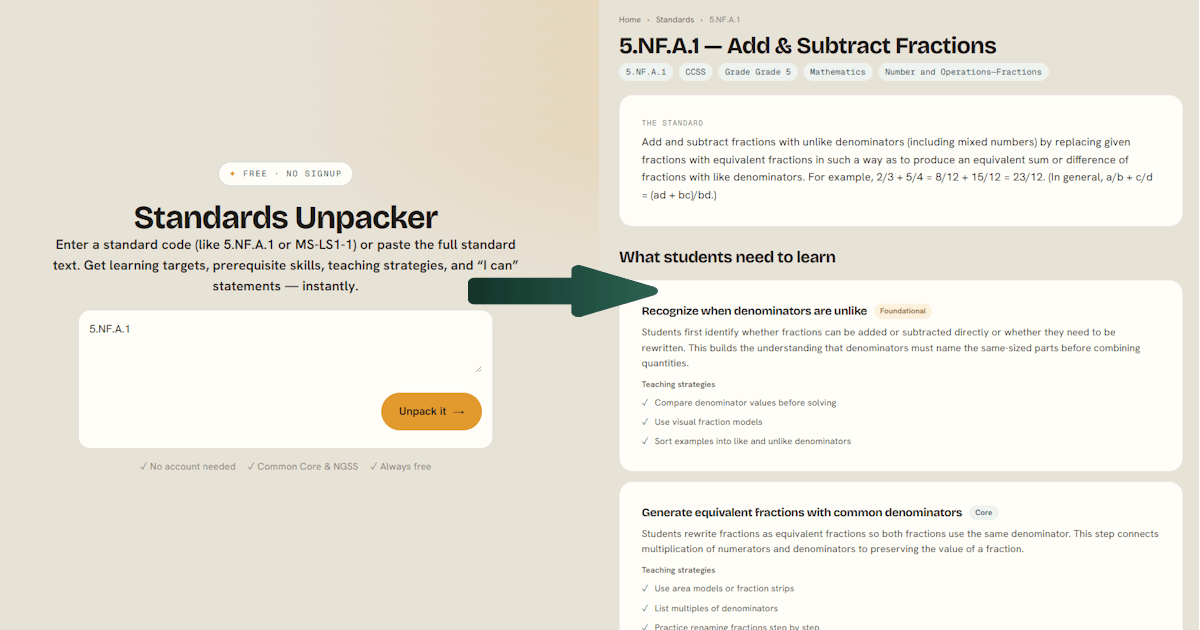
You've seen the moment. It's the second week of August, you're mapping out your first unit, and the pacing guide hands you a line like 5.NF.A.1. You know roughly what it means. But "roughly" doesn't write Tuesday's lesson — you need to know what skills are actually inside that standard, what your students need to already know, what it looks like when a kid has mastered it, and how to say it in words a ten-year-old understands.
Unpacking standards is real work. It's also the kind of work that used to eat a planning period per standard.
So here's our news: the PlanSpark Standards Unpacker is now completely free. No signup. No email address. No trial clock. Go to planspark.net/standards, type in a standard code, and a few seconds later you have the full breakdown.
What You Get for Any Standard
The official standard text, so you know you're looking at the right thing. Three to six teachable components — the actual skills hiding inside the standard — each explained in plain English, tagged as Foundational, Core, or Extension, and paired with a few concrete teaching strategies. Student-friendly "I can…" statements ready for your board or your rubric. Plus the grade level, domain, and cluster context so you can see where the standard sits in the bigger progression.
Here's a live example if you want to see one before trying your own: 5.NF.A.1 unpacked.
It covers Common Core Math (K–8 and high school), Common Core ELA/Literacy, and NGSS — 1,686 real standards recognized and validated. If you teach in a state with its own standards, you can paste the standard text instead of a code and it'll unpack that for you too.
Every Standard Gets a Permanent, Shareable Link
One of our favorite parts: when you unpack 5.NF.A.1, that page exists from then on — clean, instant, shareable. Which means the next time your grade-level team is planning together, you don't describe the breakdown; you drop the link in the group chat. PLC meeting on Thursday? Unpack the standards for the unit ahead of time and send the links around. It's the kind of resource that's most useful when the whole team is looking at the same page — literally.
Why Free, and Why This Tool?
Because unpacking is where planning starts, and we think the starting line shouldn't cost anything. PlanSpark's whole idea is one connected path — standard → lesson → rehearsal → materials, all aware of your actual students. The Unpacker is the front door to that path, and we'd rather every teacher be able to walk through it than keep it behind a trial.
And if you do want the rest of the path: from any unpacked standard, one click starts a full lesson built on it — and with a class profile, that lesson (and every worksheet, slide deck, and assessment that follows) is tailored to your students' reading levels, IEPs, and language needs. That part comes with a 7-day free trial, $6/month after. But to be clear: the Unpacker itself is just free. Use it every day and never sign up for anything. We'd genuinely love that.
One Honest Note, Teacher to Teacher
The breakdowns are AI-generated. They're built to save you prep time and give you a strong starting point — a smart teaching aid, not an official curriculum document. You're the professional; treat it like a very fast first draft from a very well-read colleague.
Planning Season Is Here
Back-to-school planning season is here. Next time a standard code stares back at you from the pacing guide, don't spend your planning period decoding it.
Unpack it free at planspark.net/standards.